Significance of Mitral Value Failure. Etiology Valvuloplasty: Eight-Year Outcomes
pp 290-299
DOI:
https://doi.org/10.7775/rac.v70i4.2775Keywords:
mitral regurgitation, etiology, mitral valve repairAbstract
Objective
To analyze 8-year outcomes of mitral valvuloplasty and how they relate to the etiology of mitral failure.
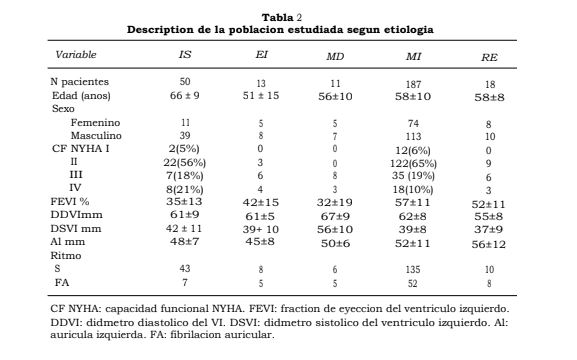
Methods From September 1992 to June 2000, 290 patients underwent mitral valvuloplasty. Mean age was 58±14 years (range 21-82); 186 patients (65%) were men. The etiology was: myxomatous in 187 patients (64%); ischemic in 50 patients (17%); rheumatic in 18 patients (6%); dilated cardiomyopathy in 11 patients (3.5%); infectious endocarditis in 13 patients (4.5%), 11 (3.5%) secondary to aortic valve disease with ventricular dysfunction. Kaplan-Meier method was used to calculate four event free parameters (CI 95%): survival, reoperation, infectious endocarditis and thromboembolism. Myxomatous etiology was compared with the rest of the etiologies by log-rank test.
Results
Overall hospital mortality was 4.2% (12 patients). In isolated mitral valvuloplasty it was 2.3% ( 4/175) while in combined surgeries it was 6.9% (8/115). Total follow-up was 44±50 months.
Survival was significantly lower in patients with ischemia and dilated cardiomyopathy than in patients with myxomatous etiology (54% at 8 years y 78% at 4 years versus MI 91 % at 8 years, p=0.04 and p=0.03). Rheumatic disease showed the highest rate of reoperations (72% vs 98%, p=0.05).
Conclusions: Mitral valvuloplasty has a low hospital mortality rate and a high event-free survival rates 8 years after surgery. Myxomatous etiology has a higher event-free survival rate compared with other etiologies.
Downloads
Published
Issue
Section
License
Copyright (c) 2026 Argentine Journal of Cardiology

This work is licensed under a Creative Commons Attribution-NonCommercial-ShareAlike 4.0 International License.