
Anti-autonomic receptor antibodies, heart rate variability and arrhythmias in patients with chagas disease
pp 109-113
DOI:
https://doi.org/10.7775/rac.v71i2.2967Keywords:
Chagas disease, Heart rate variability, Antiautonomic receptor antibodiesAbstract
Objectives Associations between Chagas disease (with or without cardiomyopathy) and the presence of anti-autonomic receptor antibodies (IgG anti-RA), heart rate variability (HRV)and severe ventricular arrhythmias (VA). Materials and methods One hundred and seven patients were enrolled. Eighty-two of them were chagasic patients, 47 in an undetermined phase of the disease, 35 with heart disease group A (according to the classification of the Consejo de Enfermedad de Chagas y Miocardiopatías Infecciosas Dr. Salvador Mazza) and ther emaining 25 were non chagasic subjects (control group).Tripanosoma cruzi infection was detected by three positivestandard serology reactions; anti-autonomic receptor anti-bodies were demonstrated by an ELISA essay. The HRVand VA were determined by a 24 hour Holter procedure.All data were submitted to statistical analysis. Chi squaretest and multiple logistic regression analysis, and Spearmancorrelation procedure were performed. Results the presence of anti-RA IgG was more frequent in chagasic patients with heart disease group A (80.0%) than in those in an undetermined phase of the disease (59.5%) and healthy subjects (8.0%; p<0.001). Moreover, VA were also more frequent in chagasic patients with heart disease group A (34.3%vs. 6.4% and 4.0%; p< 0.001); and HRV alterations were found in 28.6% of chagasic patients with heart disease group A,25.5% of chagasic patients in an undetermined phase and 4.0%of healthy subjects (p=0.04). According to Spearman correlation, the association between the presence of arrhythmias andanti-RA IgG levels was borderline (rS=0.17; P=0.07). In the multivariate analyses, the association between the presence of anti-RA IgG and Chagas disease stage was significant; on the contrary, no significant association was detected betweenIgG levels and VHRV or VA. Conclusions The presence of anti-RA IgG and heart rate variability were more frequent in chagasic patients with or without cardiomyopathy. Otherwise, ventricular arrhythmias have been seen especially in chagasic patients with cardiomyopathy.The association found between anti-RA IgG and cardiomyopathy has been significant; the association between anti-RA IgG and heart rate variability requires further investigation.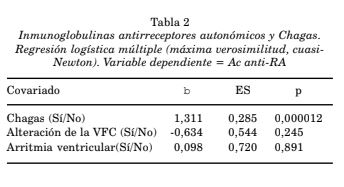
Downloads
Published
2026-02-24
Issue
Section
ORIGINAL ARTICLES
License
Copyright (c) 2026 Argentine Journal of Cardiology

This work is licensed under a Creative Commons Attribution-NonCommercial-ShareAlike 4.0 International License.





