Pharmacological Response of a Fasciculoventricular Fibre: Usefulness for its Electrocardiographic Diagnosis
pp 719-723
DOI:
https://doi.org/10.7775/rac.v68i5.3051Keywords:
Preexcitation syndromes, Fasciculoventricular fiber, Adenosine, Ajmaline, VerapamilAbstract
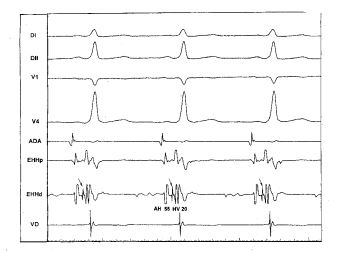
Fasciculoventricular fibers may cause an electrocardiographic pattern resembling that of the Wolff-Parkinson-White syndrome, particularly when it is associated with an abbreviated AV nodal conduction time. The diagnosis is usually established on the basis of the electrophysiologic findings. In this report we describe a patient with a fasciculoventricular fiber that could be diagnosed simply by the electrocardiographic changes induced by adenosine and verapamil. These agents caused a prolongation of the PR interval without any modification in the degree of ventricular preexcitation and even second degree AV block. Anterograde propagation on the accessory connection was blocked by ajmaline, a fact suggesting that the fasciculoventricular fibre was composed, at least in part, of a "depressed fast response" tissue. The diagnosis was confirmed by the electrophysiologic study, which also excluded the coexistence of "accelerated AV nodal conduction".
Downloads
Published
Issue
Section
License
Copyright (c) 2026 Argentine Journal of Cardiology

This work is licensed under a Creative Commons Attribution-NonCommercial-ShareAlike 4.0 International License.