
Enalapril in Unstable Angina: A Randomized Double Blind Multicenter Trial
pp 31-47
DOI:
https://doi.org/10.7775/rac.v64i1.3162Keywords:
Angiotensin converting enzyme inhibitors, Enalapril, Unstable angina, Randomised clinical trialAbstract
Background Angiotensin converting enzyme inhibition has reduced the incidence of unstable angina and myocardial infarction during long term treatment, but the effect on acute ischemic activity is still unknown. Objectives The main objective is a comparison of the incidence of a combined endpoint, "unfavorable outcome" (recurrent or refractory angina with ST segment changes, myocardial infarction, emergency revascularization procedure or death during the 7 days observation period) between enalapril and placebo. Method ENAI is a double blind controlled randomized trial designed to test the effect of enalapril versus placebo in patients admitted to CCU with unstable angina, defined as angina at rest in the last 24 hours, with ST segment or T-wave changes on the ECG without elevation of serum enzyme levels. The initial dose was 2.5 of enalapril or placebo in the first six hours, and was increased to a complete doses of5 mg every 12 hours in the first half of the study, 516 patients, and 10 mg every 12 hours in 506 patients thereafter. Results 1022 patients were included and the complete events and follow up are reported. 506 received enalapril (49.8%) and 516 placebo. Treatment was withdrawn because of adverse effects in 15.4% in enalapril and 12% in placebo group. Enalapril Placebo p level n % n % Combined end point 136 26.9 126 24.4 0.40 Recurrent angina 112 22.1 112 21.7 0.99 Refractory angina 38 7.5 41 7.9 0.88 Myocardial infarction 15 3.0 14 2.7 0.95 Urgent revascularization 38 7.3 29 5.7 0.40 Death 9 1.8 7 1.4 0.77 Conclusions Enalapril does not improve acute evolution in unstable angina. This results are in agreement with the lack of preventive effect on reinfarction and postinfarction angina in short term trial of acute myocardial infarction with ACE inhibitors. Antiischemic effects of this drug: is probably related to along term stabilization of the plaque.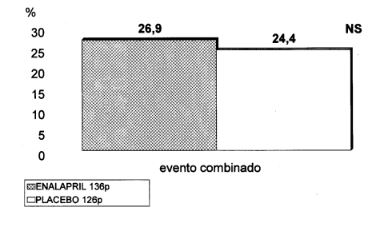
Downloads
Published
2026-03-12
Issue
Section
ORIGINAL ARTICLES
License
Copyright (c) 2026 Argentine Journal of Cardiology

This work is licensed under a Creative Commons Attribution-NonCommercial-ShareAlike 4.0 International License.





