
Effect of Right Ventricular Pacing on Interventricular Conduction Time. Its Importance for Optimizing Left Atrioventricular Interval in Patients with DDD Pacemakers
pp 131-138
DOI:
https://doi.org/10.7775/rac.v62i2.3334Keywords:
AV left, Interventricular conduction timeAbstract
Background and objectives Dual chambers DDD pacemakers are aimed at providing rate response and at preservating the physiological atrio-ventricular conduction sequence. Left heart atrioventricular sequence (which is hemodynamically more important than the fight heart one) may be affected by pacing right heart chambers. Right atrial pacing causes a delay of left atrial contraction, known as interatrial conduction time. Similarly, right ventricular pacing provokes a delay in left ventricular depolarization known as interventricular conduction time. Postponement of left ventricular systole may thus cause a lenghtening of the left heart atrioventricular interval, which is clinically manifested as a lengthening of the preejection period (interval between QRS and the upstroke of arterial pulse). The aim of this study was to determine the values of interventricular conduction time that are to be expected in pacemaker implanted patients. These values may serve the purpose of manual or automatic optimization of left heart atrioventricular interval inpatients with DDD pacemakers. Also, the independent influence of right and left heart atrioventricular intervals on left heart systolic function was evaluated. Methods and results Left heart systolic function was assessed by rate-corrected left ventricular ejection time. Interventricular conduction time was measured in 31 patients (male and female) with an age range of 15 to 95 years. These were grouped according to their intrinsic QRS: group a) with a narrow intrinsic QRS; group b) with right bundle branch block and an already prolonged interventricular conduction time. Results: 1) in patients with a narrowQRS, interventricular conduction time averaged77 ±6 msec; 2) in patients with right bundle branch block, it averaged75 ±6 msec; 3)in patients with left bundle branch block, right ventricular pacing caused an additional delay of 22 msec; 4)in patients with physiological right heart atrioventricular intervals, an optimal left heart atrioventricular interval is present, above and below which impairment of left ventricular systolic function is noted. This was manifested as a shortening of rate-corrected left ventricular ejection time of25 ±6 msec (p < 0.001), in patients with non-optimal atrio-ventricular sequence; 5) in the presence of physiological left heart atrioventricular intervals, the value of right heart atrioventricular interval did not influence left heart function. Conclusions 1) Right ventricular pacing delays left heart systole, except when left bundle branch block is present, where it is already delayed. 2) If the left heart atrioventricular interval is non-physiological, ventricular function is impaired. Ventricular function is not affected by right heart atrioventricular sequence. For left heart function optimization, and during atrial sensing-ventricular pacing, atrioventricular interval should be shortened by the length of interventricular conduction time.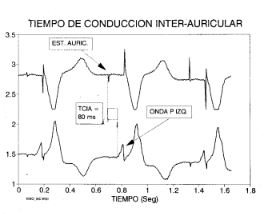
Downloads
Published
2026-03-31
Issue
Section
ORIGINAL ARTICLES
License
Copyright (c) 2026 Argentine Journal of Cardiology

This work is licensed under a Creative Commons Attribution-NonCommercial-ShareAlike 4.0 International License.





