
Myocardial Viability. Which is the Pharmacological Test to be Used?
pp 93-101
DOI:
https://doi.org/10.7775/rac.v63i2.3343Keywords:
Nitroglycerin, Amrinone, Dobutamine, Myocardial viabilityAbstract
Background
The aim of this study was to compare the usefulness of nitroglycerin, dobutamine and amrinone radionuclide ventriculography in the diagnosis of myocardial viability using Ti 201 late redistribution and reinjection as reference.
Methods
Twenty patients with coronary artery disease and aTc-99m radionuclide angiography with left ventricular ejection fraction < 40%, were prospectively enrolled. Planar TI 201 perfusion images were obtained at best septal, anterior and lateral views.For each one of these views five segments were considered. Exercise stress test, 4 hours redistribution, and reinjection protocol was done. Technetium 99m left ventricular ejection fraction was obtained at rest, in anterior and best septal positions considering five segment divisions. Also wall motion score was made based on the following classification as:dyskinesia = -1, akinesia = 0, severe hypokinesia =1, moderate hypokinesia = 2, mild hypokinesia = 3, and normal = 4. After basal images were obtained,10 y/kg/min of nitroglycerin was I.V infused, and two minutes latter left ventricular ejection fraction and wall motion score values were done. Fifteen minutes after nitroglycerin infusion was discontinued, dobutamine was administrated at increasing levels: 5, 10, 15, 20, 30 and 40 y/kg/min, obtaining for each dose, left ventricular ejection fraction and wall motion score values. Twenty minutes after the last dobutamine acquisition, 1 mg/kg of amrinone bolus was adminstrated and newer left ventricular ejection fraction and wall motion score were made. Nitroglycerin response was considered positive when left ventricular ejection fraction increased at least 10% above the rest value and wall motion score over one point. For amrinone and dobutamine, positive response was considered when left ventricular ejection fraction increased more than 20% above the rest value and wall motion score rised one point at least.
Results
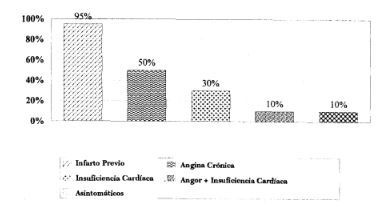
Mean age 58.5 ± 7.3 years. Eighteen were males.Nineteen (95%) had previous history of myocardial infarction, ten (50%) had angina, six (30%) with symptoms of congestive heart failure, two (10%) had both angina and congestive heart failure symptoms, and other two (10%) patients were asymptomatic. Mean basal ejection fraction andwall motion score were 29.6 ± 6.1% and 7.9 ± 2.3. Mean nitroglycerin values were 33.1 ± 5.8 % and9.8 ± 1.8 respectively. For amrinone, mean left ventricular ejection fraction was 34.2 ± 6.9% and wall motion score was 10.2 ± 2.4, and dobutamine respectively values were 41.9 ± 11% and 12.1 ± 3.4. Sensitivity, specificity, positive predictive value and negative predictive value were 41.6, 40, 62.5 and 22.2% for nitroglycerin, 91.6, 50, 73.3 and 80% for dobutamine and 46, 85.7, 85.7 and 46/ for amrinone respectively.
Conclusions
Nitroglycerin appears to be of no clinical interest in the determination of myocardial viability. On contrary, pharmacologic stimulation with amrinone and/or dobutamine is safe and useful and gives information about the amount of reversible dysfunction in patients with severely depressed left ventricular ejection fraction and coronary artery disease.
Downloads
Published
Issue
Section
License
Copyright (c) 2026 Argentine Journal of Cardiology

This work is licensed under a Creative Commons Attribution-NonCommercial-ShareAlike 4.0 International License.





