
Pharmacologic Characterization of the Vascular Response to Bradykinin in Resistance Vessels
pp 103-108
DOI:
https://doi.org/10.7775/rac.v63i2.3344Keywords:
Bradikinina, Arterias mesetericas, Indometacina, L-nitro arginina, ClotrimazolAbstract
Backgroud
Kinins are vasoactive hormones probably participating as a paracrine system i the local regulation of blood flow. Injected bradykinin has a biphasic action: vasodilation followed by vasocostriction (Fasciolo & Nolly, 1990). The mechanisms probably involved in this response are analyzed in the present paper.
Method
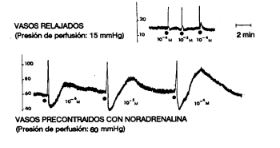
Rats mesenteric artery was canulated, perfused with salie (4 ml/mi) ad contracted with or epiephrine (10'5M-101M). The response to agonists were measured as variations in perfusion pressure. When basal values were maintained between 30-60 mmHg, bradykinin produced a slight dilation followed by a great vasocostriction. With a pressure between 70-100 mmHg, vasodilation was predominantly see. L-NAME (104M), an nitric oxyde sinthetase inhibitor and chlorotrimazol (108M), a citochrome p-45- inhibitor, sigificantly reduced (p < 0.005) the response to bradykinin. Indomethaci (1 μg/ml), a cyclooxygenase inhibitor, completely abolished the vasoconstrictive effect but only partially the vasodilation. Vasoconstriction induced by bradykinin was significantly reduced(p < 0.001) i the presence of SQ-29548, a PGH2/TXA2receptor blocker.
Conclusions
The injection of bradykinin into mesenteric vessels produce vasodilation followed by vasoconstriction and the magnitude of the biphasic effect varies in relationship with the perfusion pressure. Relaxation has two mai components (mediated by nitric oxyde and cytochrome P-450) ad one of lesser importance (mediated by prostanoyds). It is possible that the vasoconstrictive response could be mediated by arachydoic acid metabolytes (probably cyclic endoperoxides ad/or thromboxanes)
Downloads
Published
Issue
Section
License
Copyright (c) 2026 Argentine Journal of Cardiology

This work is licensed under a Creative Commons Attribution-NonCommercial-ShareAlike 4.0 International License.





