Sensitivity and Specificity of Tilt Test in Patients with Syncope of Unknown Cause
pp 389-395
DOI:
https://doi.org/10.7775/rac.v62i4.3536Keywords:
Syncope, Diagnosis, Tilt TestAbstract
Background
When using tilt test to detect neurocardiogenic syncope, its sensitivity, specificity and methodology are still under discussion. Aim of the study 1) To evaluate the incidence of positive tilt test and characteristics of responses, both in patients with syncope of unknown cause and in a control group. 2) To correlate the positiveness with different clinical variables and hemodynamic parameters observed during the study.
Material and method
Ninety five patients with syncope and 25 healthy volunteers were studied. The tilt test was considered positive when blood pressure decreased more than 30 mmHg. Responses were defined as vasovagal or vasodepressing according to the behavior of the heart rate. The relationship between tilt test positiveness and age, gender, number of episodes (total and over the last 2 months), interval since the last episode, onset of symptoms, suspicion of vasovagal etiology, basal blood pressure and heart rate (basal, maximal during tilt test and percentage of increase) were evaluated with uni and multivariate analysis.
Results
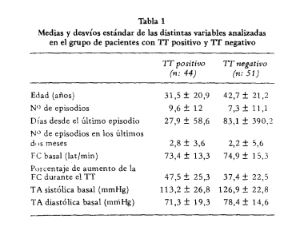
Forty four patients (46.3%) had a positive tilt test.The response was vasovagal in 77 %of cases, 22 % vasodepressing and 5 % intermediate. Syncope was observed at 26 minutes (average). Only 63% of positive tilt test occurred before 30 minutes. In the multivariate analysis, younger age and lower diastolic blood pressure showed correlation with tilt test positiveness. Three out of 25controls (12%) had a pathologic tilt test.
Conclusions
1) The incidence of positive tilt test in patients with syncope of unknown cause was relatively low. 2) Positiveness was more frequent in younger patients. 3) Vasovagal is the most frequent type of response. 4) The number of patients with pathologic tilt test after 30 minutes justifies the prolongation of the test.
Downloads
Published
Issue
Section
License
Copyright (c) 2026 Argentine Journal of Cardiology

This work is licensed under a Creative Commons Attribution-NonCommercial-ShareAlike 4.0 International License.