
Eligibility for Icosapent Ethyl in a Real-World Population of Type 2 Diabetes Patients in Argentina"
pp. 208-211
DOI:
https://doi.org/10.7775/rac.es.v93.i3.20898Keywords:
Cardiovascular risk , Residual cardiovascular risk, Hypertriglyceridemia , Icosapent ethyl, Diabetes mellitus , Cardiovascular diseaseAbstract
Background: Patients with type 2 diabetes mellitus (DM2) are at increased cardiovascular risk even when they receive lipid-lowering treatment with statins and achieve low-density lipoprotein-associated cholesterol (LDL-C) levels < 55 mg/dL. Moderate hypertriglyceridemia is common in this population and constitutes an additional risk factor. The REDUCE-IT study demonstrated that icosapent ethyl (IPE) reduces cardiovascular events by 25% in patients with atherosclerotic cardiovascular disease (ASCVD) or DM2 with risk factors and elevated triglycerides, which led to its incorporation into clinical guidelines.
Objective: The aim of this study was to assess eligibility IPE in patients with DM2 in the real world.
Methods: We conducted a descriptive and retrospective study of the patients included in the registry of Cardiometabolism of the Argentine Society of Cardiology. Patients were defined as eligible for IPE if they were between 40 and 75 years of age, had a history of ASCVD or 2 associated risk factors, were receiving statin therapy, and had a LDL-C < 100 mg/dL and triglycerides between 150 and 499 mg/dL.
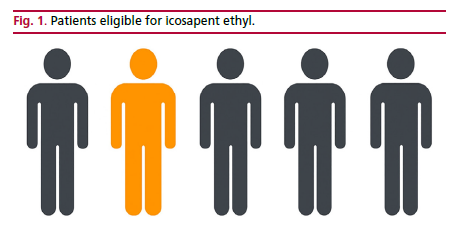
Results: A total of 694 patients with DM2 were included, of whom 601 had a complete lipid profile; 51.7 % had AVCD, and 48.3 % were in primary prevention. After applying the eligibility criteria, 19.3 % of patients were eligible to receive IPE, with a higher proportion of patients in secondary prevention (22.8 %) compared to those in primary prevention (15.5 %), OR 1.61, 95% CI 1.04-2.49; p=0.029
Conclusions: A significant proportion of patients with DM2 are eligible for treatment with IPE. These findings underscore the importance of identifying patients with DM2 who could benefit from this treatment to reduce residual cardiovascular risk.
Downloads
Published
Issue
Section
License
Copyright (c) 2025 Argentine Journal of Cardiology

This work is licensed under a Creative Commons Attribution-NonCommercial-ShareAlike 4.0 International License.





