Automatic Quantification of Volumes and Biventricular Function in Cardiac Resonance. Validation of a New Artificial Intelligence Approach
pp. 337-341
DOI:
https://doi.org/10.7775/rac.es.v89.i4.20427Keywords:
Deep Learning – Heart Diseases / Diagnostic Imaging – Open Source - Magnetic Resonance Imagin.Abstract
Background: Artificial intelligence techniques have shown great potential in cardiology, especially in quantifying cardiac biventricular function, volume, mass, and ejection fraction (EF). However, its use in clinical practice is not straightforward due to its poor reproducibility with cases from daily practice, among other reasons.
Objectives: To validate a new artificial intelligence tool in order to quantify the cardiac biventricular function (volume, mass, and EF). To analyze its robustness in the clinical area, and the computational times compared with conventional methods.
Methods: A total of 189 patients were analyzed: 89 from a regional center and 100 from a public center. The method proposes two convolutional networks that include anatomical information of the heart to reduce classification errors.
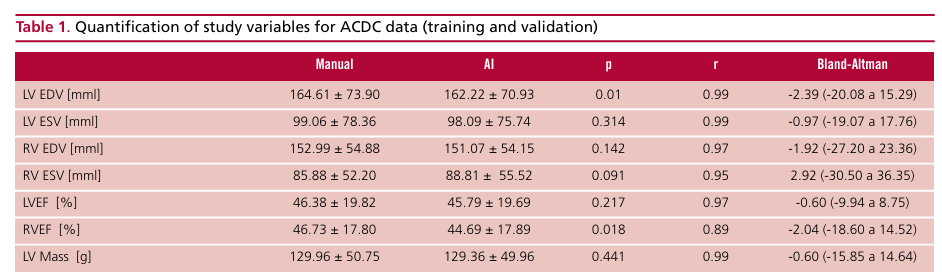
Results: A high concordance (Pearson coefficient) was observed between manual quantification and the proposed quantification of cardiac function (0.98, 0.92, 0.96 and 0.8 for volumes and biventricular EF) in about 5 seconds per study.
Conclusions: This method quantifies biventricular function and volumes in seconds with an accuracy equivalent to that of a specialist.
Curiale AH. Automatic Quantification of Volumes and Biventricular Function in Cardiac Resonance. Validation of a New Artificial Intelligence Approach. REV ARGENT CARDIOL 2021;89:337-341.
Downloads
Published
Issue
Section
License
Copyright (c) 2021 Argentine Journal of Cardiology

This work is licensed under a Creative Commons Attribution-NonCommercial-ShareAlike 4.0 International License.