Multinational and Cross-Sectional Survey on Valve-Sparing Aortic Replacement Controversies
pp. 118-129
DOI:
https://doi.org/10.7775/rac.es.v91.i2.20612Abstract
Background: The valve-sparing aortic root replacement (VSAR) has been established as a successful procedure for aortic root
aneurysms, Marfan's syndrome, bicuspid valves, and aortic dissections. However, there is a need for a consensus opinion
regarding key aspects of VSAR.
Methods: A literature review was performed regarding the most frequent debates and controversies in VSAR. An online survey
was developed based on this information, and sent to surgeons with known expertise in VSAR regarding their opinion on
patient-related factors, technical aspects, echocardiography, research, training, and the future of VSAR.
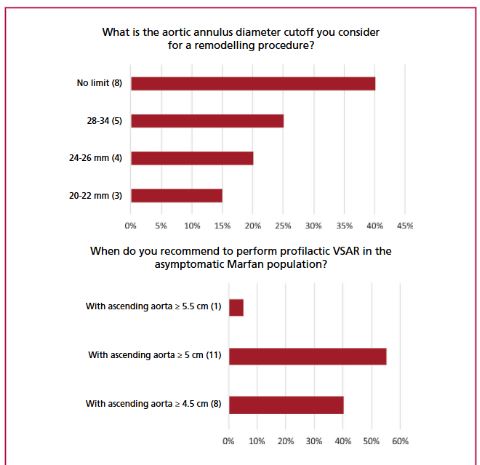
Results: Twenty surgeons completed the survey. The reduction of left ventricular ejection fraction was considered a contraindication to VSAR when severe by 14/20 surveyed. The aortic annulus diameter cutoff point for the remodeling was heterogenous
among participants. All of them felt that VSAR is safe for the Marfan´s syndrome population and bicuspid valves.
For type A dissections, 11/20 preferred this procedure only in young patients. Regarding to graft sizing, the height of the
interleaflet triangle (8/20) and the sino-tubular diameter (7/20) were the more frequent considered parameters. Surgeons
reported a 7% of failure rate, leading to conversion to Bentall surgery, and a 26% change of strategy intraoperatively. A minimally
invasive approach was not considered to improve results. Most of the surgeons agreed that VSAR should be performed
by high-experienced surgeons.
Conclusions: The VSAR has been accepted as a treatment option for the aortic root´s aneurysms, and even though there is
still not possible to reach a final consensus, a valuable experience from the most relevant surgeons in the field is presented.
How to cite this article:
Fortunato GA, Misfeld M, Tirone D, Feindel CM, Schäfers HJ, Borger MA et al. Multinational and Cross-Sectional Survey on Valve-Sparing Aortic Replacement Controversies. Rev Argent Cardiol 2023;91:118-9
https://doi.org/10.7775/rac.v91.i2.20612
Downloads
Published
Issue
Section
License
Copyright (c) 2023 Argentine Journal of Cardiology

This work is licensed under a Creative Commons Attribution-NonCommercial-ShareAlike 4.0 International License.