
Role of Thioredoxin-1 on Myocardial Stunning in Transgenic Mice
pp.
DOI:
https://doi.org/10.7775/rac.es.v83.i5.6998Keywords:
Myocardial Stunning, Oxidative Stress, Thioredoxins, Ventricular FunctionAbstract
Background: Postischemic ventricular dysfunction (myocardial stunning) involves increased oxidative stress. In this sense, the cell has defense mechanisms, as thioredoxin-1, an antioxidant that protects the myocardium from ischemia/reperfusion injury, reducing infarct size.
Objective: The aim of this study was to evaluate systolic and diastolic ventricular function, specifically analyzing myocardial stiffness and isovolumic relaxation, during myocardial stunning in different transgenic mice.
Methods: Hearts from mice overexpressing thioredoxin-1 and transgenic mice overexpressing thioredoxin-1 with gene mutation in its active site (dominant negative) were compared with hearts from non-transgenic mice after 15-minute global ischemia and 30-minute reperfusion using the Langendorff technique. Systolic and diastolic ventricular function was evaluated and t63 was calculated as ventricular relaxation index.
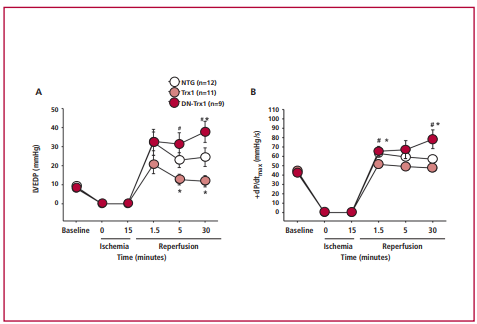
Results: At 30-minute reperfusion, thioredoxin-1 mice showed a significantly improved contractile state (57.4±4.9 mmHg; p ≤ 0.05 vs. non-transgenic mice) and stiffness (11.8±2.9 mmHg; p ≤ 0.05 vs. non-transgenic mice). Conversely, at the same reperfusion time, dominant negative mice exhibited increased stiffness (37.7±5.5 mmHg; p ≤ 0.05 vs. non-transgenic mice) and slower relaxation (78.2±9.8 ms; p ≤ 0.05 vs. non-transgenic mice).
Conclusion: This study reveals the protective role of thioredoxin-1 on myocardial stunning and its pathophysiological importance in mice overexpressing this antioxidant.
Downloads
Published
Issue
Section
License
Copyright (c) 2025 Argentine Journal of Cardiology

This work is licensed under a Creative Commons Attribution-NonCommercial-ShareAlike 4.0 International License.





