
El strain longitudinal en reposo no predice el resultado del eco estrés
pp 330-335
DOI:
https://doi.org/10.7775/rac.es.v85.i4.8530Keywords:
2D longitudinal strain, Speckle tracking, Stress echocardiography.Abstract
Background: Stress echo shows ischemia as a transient regional motility disorder. The subjective visual analysis which is dependent on the operator’s experience has prompted the search for a semiautomatic method to mitigate this limitation and improve the reliability and reproducibility of the test. This has generated a growing interest in the introduction of two-dimensional longitudinal
strain before, during and after stress echo. If useful, its assessment during the different stress stages would attenuate other limitations, such as the inability to achieve submaximal heart rate, difficult visualization of more subtle disorders and delay in image acquisition, which increases false negative results.
Objectives: The aim of this study was to assess whether longitudinal strain analysis at rest is able to predict the outcome of stress echo when there is no visual evidence of contractile disorders, and whether baseline longitudinal strain is different in patients with significant coronary artery disease compared with patients not presenting this disease (in their previous evaluation before the test).
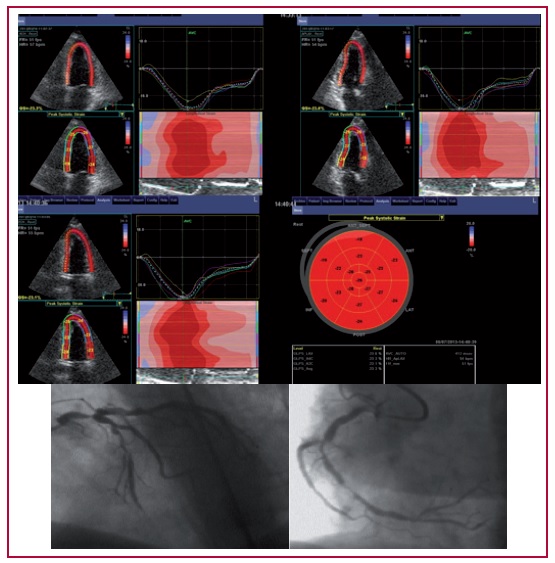
Methods: The study compared longitudinal strain results at rest in 62 patients with positive stress echo consecutively recruited during a 12-month period, half of whom underwent coronary angiography(Group A) and the other half did not undertake this study(Group B) versus a control group (Group C) with negative test and without coronary angiography.
Results: Longitudinal strain showed no significant difference between groups A and B (-21.8%±2.4% vs. -21.5% ±2.5%) and neither between patients with positive test (Group A+B) versus Group C (-21.67 % ±2.4% vs. -21.9 %±2.8%).
Conclusions: Two-dimensional longitudinal strain did not predict stress echo results or the presence of significant coronary artery disease in the group of patients undergoing invasive coronary angiography.
Downloads
Published
Issue
Section
License
Copyright (c) 2025 Argentine Journal of Cardiology

This work is licensed under a Creative Commons Attribution-NonCommercial-ShareAlike 4.0 International License.





