Fluoroscopic Detection of Coronary Artery Calcification may Predict Long-Term Mortality
pp 304-307
DOI:
https://doi.org/10.7775/rac.es.v82.i4.3512Keywords:
Coronary calcification, Mortality, FluoroscopyAbstract
Introduction: Coronary artery calcification is a marker of atherosclerosis. Fluoroscopy is a simple and accessible method to detect coronary artery calcification.
Objective: The aim of this study was to evaluate the value of fluoroscopic detection of coronary artery calcification as an independent predictor of all-cause mortality and long-term cardiovascular mortality.
Methods: A prospective cohort of subjects aged ≥45 years without documented cardiovascular disease underwent fluoroscopic examination to identify the presence of coronary artery calcification. A Cox regression model was used to evaluate the independent effect of calcification as a predictor of long-term mortality.
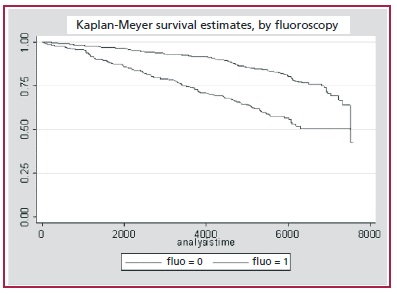
Results: A total of 857 persons were included in the study. Follow-up was completed in 98.7% of cases with an average of 14.4± 4.3 years (range: 34 days to 20.8 years). Mean age was 61.3 ± 9.7 years, 88.9% had hypertension, 19.6% had high cholesterol levels, 1.8% had diabetes and 52.7% were men. Coronary artery calcification was detected in 264 patients (32%). The presence of coronary artery calcification was associated with age, male gender and high cholesterol levels. All-cause long-term mortality was 28.3% and cardiovascular mortality was 14.9%. The presence of coronary artery calcification was an independent predictor of all-cause mortality (HR 1.6, 95% CI 1.2-2.0; p= 0.002) and cardiovascular mortality (HR 2.5, 95% CI 1.6-3.9; p = 0.002). All-cause mortality without calcification was 1.35 per 100 patient-years and 3.39 per 100 patient-years with calcification [p (log rank test) < 0.0001].
Fluoroscopic detection of coronary artery calcification may predict long-term all-cause and cardiovascular mortality in a population without documented cardiovascular disease.
Downloads
Published
Issue
Section
License
Copyright (c) 2025 Argentine Journal of Cardiology

This work is licensed under a Creative Commons Attribution-NonCommercial-ShareAlike 4.0 International License.