Thioredoxin-1 Reduces Infarct Size But Does Not Improve Postischemic Ventricular Dysfunction
pp. 202-207
DOI:
https://doi.org/10.7775/rac.es.v81.i3.2146Keywords:
Myocardial Ischemia, Reperfusion, Myocardial infarction, Ventricular function, Antioxidants, ThioredoxinAbstract
Background: Thioredoxin-1 is a potent endogenous antioxidant involved in myocardial protection from ischemic/reperfusion injury. However, it is unknown whether this protection is preserved in middle age or whether exist a dissociation between the effect on ventricular function and infarct size.
Objective: The purpose of this study was to compare infarct size and ventricular function in young and middle-aged transgenic mice overexpressing thioredoxin-1 with their corresponding wild-type controls.
Methods: Isolated hearts of 3-month (young) and 12-month (middle-age) FVB male mice were submitted to 30 minutes of global ischemia and 120 minutes of reperfusion using the Langendorff technique. Four experimental groups were considered: young wild-type, middle-aged wild-type, young thioredoxin-1 and middle-aged thioredoxin-1. Left ventricular function was assessed and infarct size was measured with triphenyl tetrazolium.
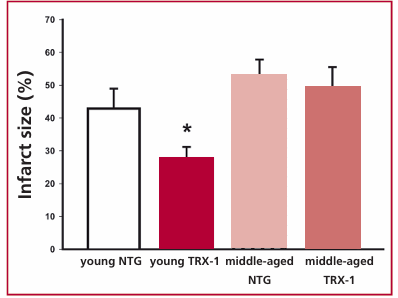
Results: Ventricular function showed no significant differences between the studied groups. However, young thioredoxin-1 mice reduced infarct size (27.6% ± 3.5% vs. 42.9% ± 6.1% young wild-type mice); conversely, the middle-aged thioredoxin-1 group was not significantly different from its wild-type control (49.1% ± 6.4% vs. 52.6% ± 5.2%).
Conclusions: Results suggest that young mice overexpressing thioredoxin-1 reduce infarct size, but without changes in ventricular function. Moreover, the protective antioxidant effect is abolished in middle-aged transgenic mice.
Downloads
Published
Issue
Section
License
Copyright (c) 2025 Argentine Journal of Cardiology

This work is licensed under a Creative Commons Attribution-NonCommercial-ShareAlike 4.0 International License.