
Effects of Rosuvastatin on Experimental Infarction in Normal and in Hypercholesterolemic Rabbits
pp 118-123
DOI:
https://doi.org/10.7775/rac.v76i2.2446Keywords:
Myocardial infraction, Rosuvastatin, Pyrimidines, Hypercholesterolemia, Ventricular functionAbstract
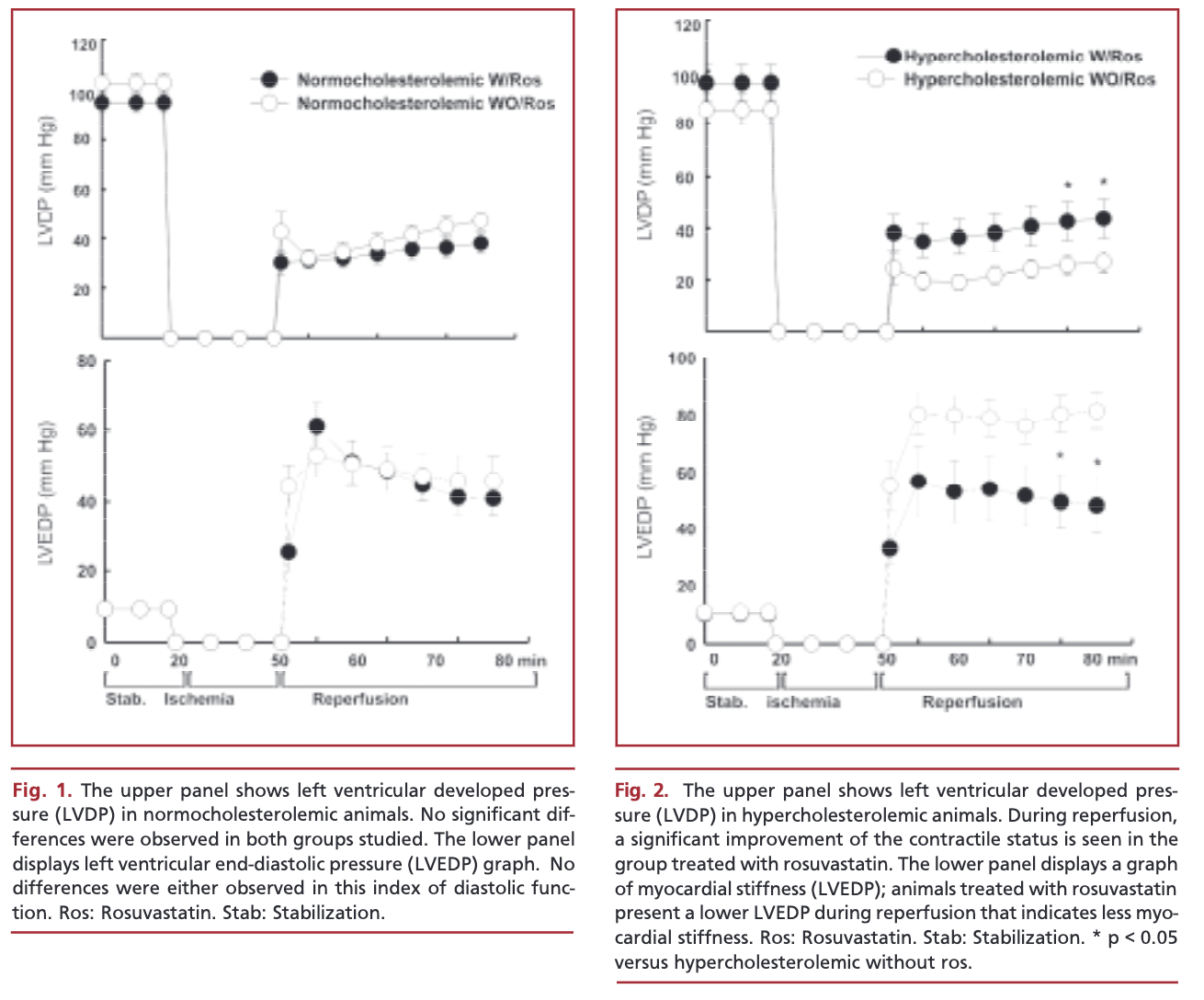
It is well accepted that previous treatment with rosuvastatin may reduce infarct size and improve ventricular dysfunction. Nevertheless, there is no experimental evidence of this action when administered during reperfusion. The objective of the present study was to assess if the administration of rosuvastatin during reperfusion might modify not only the infarct size but also ventricular function recovery after an ischemic episode in normocholesterolemic and hypercholesterolemic rabbits. Isolated and isovolumic rabbit hearts were perfused according to Langendorff technique. Rabbits in group 1 (G1) under- went a 30-minute global ischemia followed by a reperfusion lasting for 120 minutes. Rosuvastatin (50 μM) was administered to rabbits in group 2 (G2) throughout the whole reperfusion. Protocols G1 and G2 were repeated in groups 3 and 4 (G3 and G4), respectively, but in rabbits previously fed for a month with a 1% cholesterol-rich diet. Total cholesterol levels were 59.6 ± 9.3 mf/dl before treatment with the diet, and after a cholesterol rich diet for 4 weeks, cholesterol levels increased to 185.4 ± 21.4 (p < 0.05). No differences among recovery in left ventricle developed pressure (LVDP) or in end-diastolic left ventricle pressure (EDLVP) were reported in normocholesterolemic animals. Nevertheless, the administration of rosuvastatin mitigated systolic and diastolic post-ischemic left ventricular dysfunction. Infarct size in G1 and G3 was 16.6 ± 2.6 y 25.6 ± 2.7, respectively (p < 0.05). Administration of rosuvastatin reduced the infarct size in G2 and G4 to 4.5 ± 1.1 y 5.5 ± 1.6 (p < 0.05), respectively. The administration of rosuvastatin since the beginning of reperfusion reduces the infarct size in normocholesterolemic and hypercholesterolemic rabbits, and improves ventricular function only in hypercholesterolemic animals.
Downloads
Published
Issue
Section
License
Copyright (c) 2025 Argentine Journal of Cardiology

This work is licensed under a Creative Commons Attribution-NonCommercial-ShareAlike 4.0 International License.





