Aortic Valve Replacement via Mini-sternotomy and Rapid-Deployment Valves: Are We on the Right Track?
pp. 270-275
DOI:
https://doi.org/10.7775/rac.es.v94.i4.21029Keywords:
Aortic valve stenosis, Aortic valve replacement, Minimally invasive cardiac surgery, Rapid deployment valvesAbstract
Background: Aortic stenosis (AS) is the most common valvular heart disease in developed countries, and its management has evolved toward techniques that reduce surgical risk and accelerate recovery, especially in elderly patients. Among these innovations are rapid deployment valves (RDV), which combine the durability of conventional surgical prostheses with anchoring mechanisms derived from transcatheter aortic valve implantation (TAVI), reducing cardiopulmonary bypass (CPB) and aortic clamping times and facilitating minimally invasive approaches such as mini sternotomy.
Objectives: The objective of this study was to evaluate 30-day and 1-year mortality following aortic valve replacement (AVR) via mini-sternotomy using INTUITY RDV. Secondary objectives included the analysis of intraoperative and postoperative complications and trans prosthesis gradients during the first 30 days after surgery.
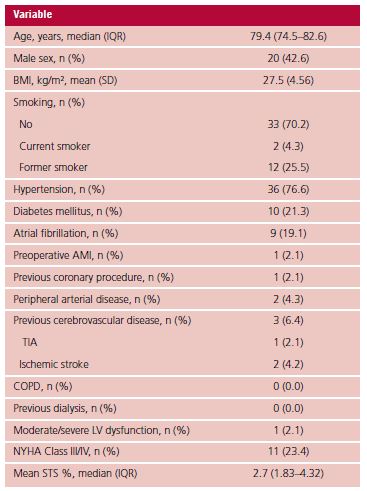
Methods: A single-center, retrospective, observational study was conducted, including 47 patients between 50 to 85 years of age who underwent surgery for severe AS between 2018 and 2024. All patients underwent AVR with INTUITY RDV via mini sternotomy. Clinical, intraoperative, and postoperative variables were analyzed, together with pre- and post-implantation transprosthetic gradients.
Results: The procedures were successfully completed in 100% of cases, with no conversions to full sternotomy. Median CPB time was 90 minutes, and median clamping time was 65 minutes. The incidence of paravalvular leak was minimal. In the postoperative course, atrial fibrillation was the most common complication (40.4%). Median hospital length of stay was 7 days. No myocardial infarctions, pacemaker implantations, or 30-day mortality were recorded, while one-year mortality was 2.1%. The hemodynamic results were favorable: the maximum gradient decreased from 73.9 ± 21.3 mmHg to 17.2 ± 6.9 mmHg, and the mean gradient from 44.5 ± 13.3 mmHg to 8.6 ± 3.7 mmHg (p < 0.001 in both cases). No cases of thrombosis or moderate-to-severe paravalvular leak were observed.
Conclusion: The combination of RDV and a minimally invasive approach proved to be safe, with low morbidity and mortality and excellent short-term hemodynamic improvement.
Downloads
Published
Issue
Section
License
Copyright (c) 2026 Argentine Journal of Cardiology

This work is licensed under a Creative Commons Attribution-NonCommercial-ShareAlike 4.0 International License.