
Assessment of Coronary Flow Reserve by Transthoracic Doppler Echocardiography
pp 383-398
DOI:
https://doi.org/10.7775/rac.v68i3.3132Keywords:
Coronary flow reserve, Transthoracic Doppler, Cell echocardiography, Adenosine , DipyridamoleAbstract
Introduction
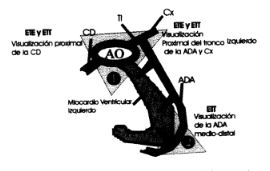
The coronary flow reserve is an important index for the assessment of coronary function. The possibility of performing this determination by a to-tal non-invasive method will allow its more extensive utilization in the clinical practice.ObjectivesThe aim of the study was to evaluate the feasibility and the relevance of the coronary flow reserve measured with transthoracic Doppler echocardiography.
Material and methods
Two-hundred and eleven patients were prospectively studied (125 men, mean age 64.5 ±11.5 years). The coronary flow velocity was continuously monitored by pulsed-wave Doppler at the distal region of the left anterior descending artery -at rest and during the hyperemic phase induced by the infusion of adenosine for 2 min (41 patients) or 0.84mg/kg/min of dipyridamole for 4 min (170 patients)-. The coronary flow reserve was calculated as the ratio between the maximal coronary flow velocity and the basal diastolic velocity. These data were related with the angiograms performed the week after the transthoracic Doppler echocardiography in 62 patients. The results of the patients with a non significant left anterior descending artery stenosis (< 70%), (groupA=39 patients) were compared with the remaining with significant disease (>_ 70% lesion, groupB =23 patients).
Results
A good Doppler recording of blood flow velocity was obtained in 206/211 patients (feasibility 97.6%). The basal diastolic velocity did not present significant differences in either of the two groups (24.6±5.6 versus 27.4 ±9.8cm/sec.). The value of diastolic velocity post-vasodilation was 61.18 ±20 cm/sec in group A, whereas in group B, it was 37.3 ±16.0 cm/sec (p<0.0001). The diastolic coronary flow reserve was considerably greater in the population with-out significant lesion in the left anterior descend-ing coronary artery than in the patients with>_ 70%stenosis (2.56 ±0.8 vs. 1.32 ± 0.23, p < 0.0001).A coronary flow reserve>_2 was registered in 29/39 patients with<70% stenosis of the left anterior descending artery (specificity of 74%, CI 95% 57.6-86.4). The 10 patients with lower values exhibited severe aortic stenosis(2patients), AMI with normal coronary arteries (2patients), dilatated miocardiopathy (3 patients), LAD 60% stenosis (2patients) and after by-pass with patent mammary graft and native LAD with minimal lesion (1 patient). A coronary flow reserve<2 was obtained in all the patients with critical left anterior descend-ing stenosis (100% sensitivity, CI 95% 82.2-99.6.
Conclusions
Coronary flow reserve assessed by transthoracic Doppler echocardiography, in the left anterior descending artery, was of clinical usefulness in the non-invasive assessment of functionally significant disease, validated by coronary angiography.
Downloads
Published
Issue
Section
License
Copyright (c) 2026 Argentine Journal of Cardiology

This work is licensed under a Creative Commons Attribution-NonCommercial-ShareAlike 4.0 International License.





