
Conarec II Project: Analysis of the Pre-Coronary Care Unit Delay Factors in Patients with Acute Myocardial Infarction in the Argentine Republic
pp 55-64
DOI:
https://doi.org/10.7775/rac.v62i1.3218Keywords:
Prestación de salud, Infarto agudo de miocardioAbstract
Background and objectives The importance of early coronary care unit admission of patients suffering acute myocardial infarction needs not to be stressed. Consequently, the purpose of our study was to identify the factors that may prolong the time elapsed between the onset of acute myocardial infarction symptoms and hospital admission, which provides unique and essential information for health professionals. Methods and results Three hundred patients with acute myocardial infarction, consecutively admitted to 20 different coronary care units were prospectively analyzed. The time elapsed between the on set of acute myocardial infarction symptoms and the first medical contact, between medical contact and emergency ward arrival, and between emergency ward and coronary care unit admission were evaluated. Sixteen social and clinical variables that might be related to prolongation of the time intervals mentioned above were also analyzed. Our results which are expressed as the median time interval and their respective 25% and 75 % percentiles, are the following: 90 minutes (30-360) for onset of acute myocardial symptoms-medical contact interval,87.5 minutes(30-220) for medical contact-emergency ward interval and 45 minutes (20-120)for emergency ward-coronary care unit interval. Variables associated to prolongation of onset of symptoms-medical contact time were older age, low educational level, presence of previous angina, being alone at the on set of symptoms, being at home and lower pain intensity. The medical contact-emergency ward interval was increased inpatients not owning cars. The emergency ward coronary care unit time was inversely proportional to chest pain intensity: It was longer in those patients with less pain. Conclusions These data dearly indicate that delays in coronary care unit admission for patients with acute myocardial infarction are closely related to socioeconomic and cultural determinants. This information must reach healthcare professionals in order to develop community educational programmes.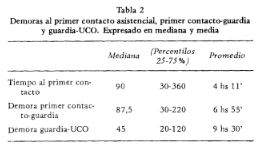
Downloads
Published
2026-03-31
Issue
Section
ORIGINAL ARTICLES
License
Copyright (c) 2026 Argentine Journal of Cardiology

This work is licensed under a Creative Commons Attribution-NonCommercial-ShareAlike 4.0 International License.





