
Analysis of Administrative and Financial Delays in the Process Leading to Transcatheter Aortic Valve Implantation: Real-World Experience in Argentina
pp. 181-186
DOI:
https://doi.org/10.7775/rac.es.v94.i3.21003Keywords:
Aortic Valve Stenosis, Transcatheter Aortic Valve Replacement, Organizational EfficiencyAbstract
Background: Severe aortic stenosis (AS) is one of the most prevalent valvular heart diseases worldwide. Transcatheter aortic valve implantation (TAVI) has become an effective and safe therapeutic alternative across different surgical risk profiles. However, differences in access to the procedure and delays between the therapeutic decision and implantation vary substantially across healthcare systems.
Objective: The aim of this study was to analyze the procedural timelines between key stages of the diagnostic–therapeutic process and TAVI implantation in the real-world clinical practice of three Argentine centers, comparing two periods defined by institutional reorganization, in order to identify opportunities for organizational optimization.
Methods: A multicenter, observational, retrospective cohort study was conducted including 71 consecutive patients with symptomatic severe aortic stenosis (AS) who underwent TAVI between January 2022 and August 2025. Three procedural intervals were evaluated: first contact (FC) with an interventional cardiologist-implantation, computed tomography (CT)-implantation, and valve request–implantation. The intervals are presented as the median and interquartile range (IQR). Differences between periods were analyzed using the Mann–Whitney U test.
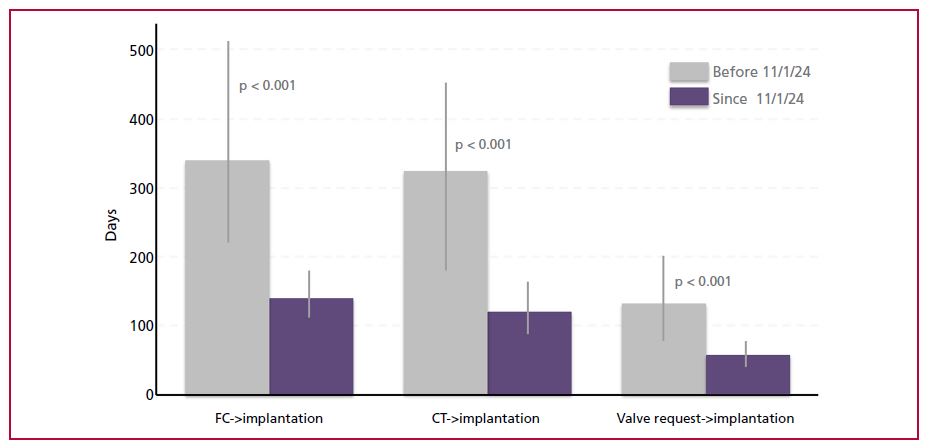
Results: The overall median intervals were 165 days (IQR 118–258) for FC–implantation, 145 days (IQR 98–216) for CT–implantation, and 67 days (IQR 45–112) for valve request–implantation. After institutional reorganization (November 2024), a significant reduction was observed in all three intervals (p <0.001), with new medians of 138, 117, and 56 days, respectively.
Conclusions: Substantial delays were identified in the pre-TAVI process within the Argentine healthcare system, with a marked reduction following the implementation of organizational measures. Optimizing interinstitutional and administrative coordination emerges as a key strategy to improve procedural efficiency .
Downloads
Published
Issue
Section
License
Copyright (c) 2026 Argentine Journal of Cardiology

This work is licensed under a Creative Commons Attribution-NonCommercial-ShareAlike 4.0 International License.





