
AMI-1999 Registry
pp 488-500
DOI:
https://doi.org/10.7775/rac.v69i5.3845Keywords:
Myocardial infarction, Thrombolysis, Coronary angioplasty, Secondary preventionAbstract
Background and objective
Acute myocardial infarction (AMI) is one of the leading causes of death in Argentina according to the INDEC. There are wide variations in the management of AMI patients with persistent TST elevation across nations, regions and hospitals. The current survey was conducted to determine the reperfusion strategies employed in AMI with TST, the factors driving the choice of treatment in the current medical practice, as well as their relation with in-hospital prognosis.
Material and method
Three hundred and seventy seven patients admitted to 85 centers (CCUs or ICUs) due to AMI with persistent TST were prospectively enrolled in the study. Patients were excluded if they were admitted more than 24 hours after AMI onset, with non-Q wave AMI or if they were admitted and submit-ted to rescue invasive procedures after initial assistance in another medical center. An in-hospital follow up was conducted to determine the occurrence of events (incidence rates of death, post-AMI angina, reinfarction, and stroke).
Results
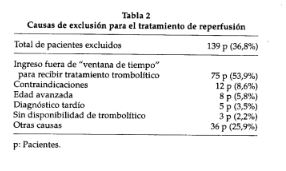
Mean age was 61.7 ±12 years old,77.7% were male and 13.5% had previous history of AMI;73.7%of the patients were admitted within the first 6 hours of AMI evolution, 44.4% had an anterior AMI, and20.2% a Killip-Kimball index>_A. A percentage of63.1% of the patients received reperfusion treatment (73.5% thrombolytics and 26.5% primary angioplasty). Among the patients who did not receive reperfusion treatment, 53.9% were admitted to the participating medical center more than 12 hours after the onset of symptoms (main reason for not administering reperfusion treatment). The in-hospital incidence of events was post-AMI angina9.5%, reinfarction 3.4%, stroke 1.9% and death 10.1%. Patients not receiving reperfusion treatments were significantly older (group of 65.2 ± 13 years old with no reperfusion treatment versus 60.1± 12 years old treated with thrombolytics and 61.1± 11 years old with angioplasty; p < 0.05, respectively). No other significant differences were observed between the three groups. A 50% of the patients had hypercholesterolemia; however, only 7.7% of the patients received lipid-lowering treatment before admission and 18.7% after hospital discharge.
Conclusions
The present national registry shows the demographic and clinical characteristics, treatments, in-hospital evolution and resource utilization in patients with persistent TST AMI in Argentina.
Downloads
Published
Issue
Section
License
Copyright (c) 2026 Argentine Journal of Cardiology

This work is licensed under a Creative Commons Attribution-NonCommercial-ShareAlike 4.0 International License.





