
Preinfarction Angina Limits Infarcts Size
pp. 73-81
DOI:
https://doi.org/10.7775/rac.v65i1.4105Keywords:
Ischemia, Preconditioning, Acute myocardial infactionAbstract
Background
Previous reports suggest that patients with myocardial infarction preceded by angina have smaller infarcts than patients without preinfarction angina but the reason for this finding is unclear. The mechanisms could be : collateral channels, previous pharmacological treatment, early reperfusion and ischemic preconditioning . In order to analize the possible influence of previous angina on infarct size in a cohort of patients prospectively included in a trial comparing fibrinolitics versus primary angioplasty in myocardial infarction, we compared infarct size by peak of CK between patients with or without previous angina.
Material and method
Patients with first anterior myocardial infarction within 6 hours of symptoms onset were included. Previous angina was defined as chest pain episodes limited to the 24 hours before myocardial infarction. Serial EKG and blood samples for CK determinations were obtained during the first 24 hours.
Analysis
Area at risk, clinical reperfusion, time to achieve reperfusion, infarct size and amount of myocardium saved were analized . In the patients allocated to primary angioplasty, infarct related artery TIMI flow postprimary angioplasty and collateral flow were also assessed .
Results
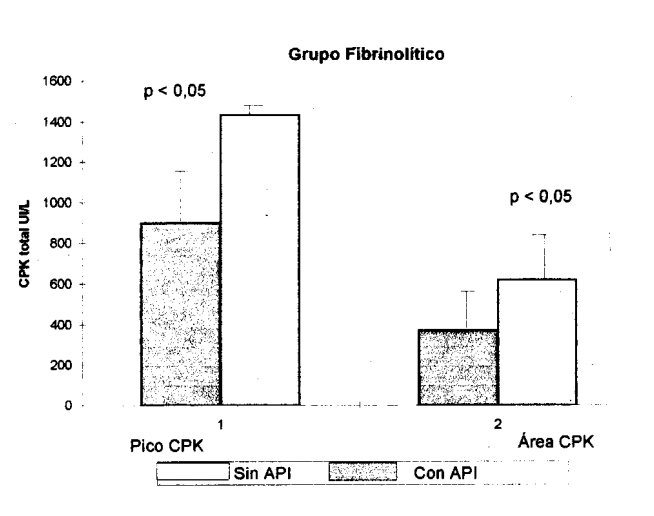
Between October 1993 to September 1995, 48 patients completed the requirements for analysis . In patients treated with fibrinolytic, baseline clinical characteristics were similar in those with or without previous angina . There were no significant differences in the area at risk, time to reperfusion and success of clinical reperfusion between patients with or without previous angina . Peak of CK was
markedly lower in patients with previous angina (898 ± 506 versus 1434 ± 736 IU/l; p = 0.04) . The ST-Q ratio was greater in the patients with previous angina (2 .0 ± 1 .7 versus 0.3 ± 1 .3; p = 0 .009) . In patients with primary angioplasty, no differences were observed in baseline characteristics between patients with and without previous angina . Infarct size showed to be higher in patients without previous angina (peak of CK 1511 ± 890 IU/l) than in patients with previous angina (peak of CK 652 ± 402 IU/l; p = 0 .032) . Time to reperfusion and rate of positive reperfusion were again similar between both groups. TIMI 3 flow was obtained in all patients independently of presence of previous angina; collateral blood flow did not show significant differences either.
Conclusion
In our population (fibrinolitic and primary angioplasty groups), patients with previous angina showed significantly smaller infarct size compared with patients without previous angina. Since the patients with previous angina and patients without angina had similar area risk, previous medication, time to reperfusion or collateral circulation, the protection afforded by angina might be ex-
plained by occurrence of ischemic preconditioning .
Downloads
Published
Issue
Section
License
Copyright (c) 2026 Argentine Journal of Cardiology

This work is licensed under a Creative Commons Attribution-NonCommercial-ShareAlike 4.0 International License.





