
High Blood Pressure in Young Patients and its Association with Other Risk Factors. Importance of Searching for Hypertensiom at All Ages
pp. 171-176
DOI:
https://doi.org/10.7775/rac.es.v93.i3.20891Keywords:
Hypertension, Atheromatous disease, Cardiovascular Risk Factors, Primary preventionAbstract
Background: Hypertension (HTN) is the risk factor with the greatest impact on cardiovascular (CV) disease. Several studies indicate that HTN can be present from an early age and that its adequate treatment is key to prevent organ damage and CV events. However, young adults are often unaware of their blood pressure (BP) levels.
Objective: The aim of this study was to evaluate the prevalence of HTN in young patients and its association with other cardiovascular risk factors (CVRF).
Methods: A cross-sectional observational study with prospective follow-up evaluated patients aged 18-49 years, participating in a CV prevention program between January 2017 and December 2023. Elevated BP was defined as ≥140 mmHg systolic blood pressure (SBP) or ≥90 mmHg diastolic blood pressure (DBP). Patients with pre-existing HTN, on antihypertensive treatment, or with secondary HTN were excluded. The study included echocardiograms to measure left ventricular mass index (LVMI) and left atrial (LA) size, and ergometric testing to assess the hypertensive response to stress (SBP ≥210 mmHg or DBP ≥90 mmHg). Multiple logistic regression analyses were performed to determine the association of HTN with other CVRF.
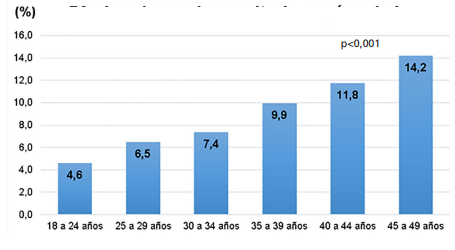
Results: Among a total of 6071 participants (mean age 35.3 ± 9.6 years, 45.3% women), 576 (9.5%) showed elevated BP at consultation. Patients with HTN were older and had higher values of body mass index (BMI), glycemia, creatinine and lipid parameters (total cholesterol, LDL-c, HDL-c and triglycerides). In the HTN group (HTNg), 73.8% had elevated SBP, 91.1% elevated DBP and 64.9% had both elevated values. The prevalence of HTN was higher with increasing age. In the ergometric test, patients with HTN presented lower performance: 12.2±2.8 METS vs. 13±2.8 METS in the control group (CTRLg) , p<0.001; and an exaggerated hypertensive response: 8.3% vs. 1%, p<0.001. The LVMI was also higher in the HTNg: 66±16 g/m2 vs. 62.5±14.5 g/m2 (p<0.001), as well as the LA diameter: 35.9±5 mm vs. 33.9±4.9 mm (p<0.001). Multiple logistic regression analysis showed that age (OR 1.049, 95% CI 1.034-1.065), HDL-c (OR 0.985, 95% CI 0.973-0.996), triglycerides (OR 1.002, 95% CI 1.000-1.003), LA diameter (OR 1.048, 95% CI 1.019-1.078) and hypertensive response on the stress test (OR 8,897, 95% CI 5,151-15,367) were independently associated with the presence of HTN.
Conclusion: A significant number of young patients with HTN was found in a control medical consultation. This finding was significantly associated with factors that increase cardiovascular risk (CVR), demonstrating that it is not an innocent finding. Early identification, categorization and treatment of this population is a priority to prevent the onset of cardiovascular events.
Downloads
Published
Issue
Section
License
Copyright (c) 2025 Argentine Journal of Cardiology

This work is licensed under a Creative Commons Attribution-NonCommercial-ShareAlike 4.0 International License.





