
Prevalence, Predictors and Clinical Impact of Readmission in Patients with Aortic Stenosis Evaluated by a Heart Team
pp. 478-483
DOI:
https://doi.org/10.7775/rac.es.v89.i6.20456Keywords:
Aortic stenosis, Readmission, MortalityAbstract
Background: There is scarce evidence in our setting regarding the prevalence of readmission, risk factors and clinical evolution of patients with severe aortic stenosis (AS) evaluated by a Heart Team.
Objective: The aim of this study was to assess the prevalence, predictors and clinical evolution of readmission in patients with severe AS evaluated by a Heart Team.
Methods: This was an observational, single-center, retrospective cohort study including patients with severe AS evaluated by a Heart Team. Total cohort characteristics were analyzed at baseline, and after stratification according to the presence or absence of readmission during a 2-year follow-up period.
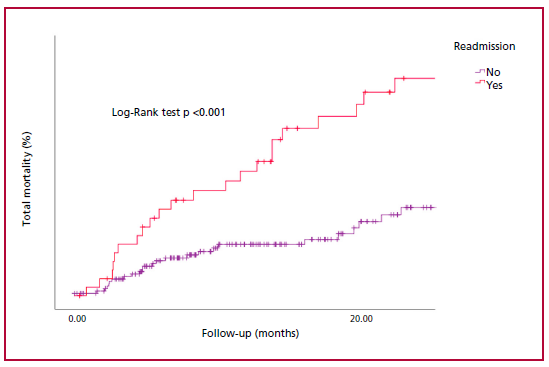
Results: Mean population age (n = 275) was 83.3 ± 6.9 years, and 51.1% were female patients. The prevalence of readmissions was 21.5%. Readmitted patients were older (85.54 ± 6.66 vs. 82.62 ± 6.87 years; p = 0.003) and had greater frailty (97,4% vs. 89.3%; p = 0.035), surgical risk (STS 6.11 ± 4.79 vs. 4.72 ± 4.12; p = 0.033), and previous history of atrial fibrillation (AF) (40.7% vs. 23.6%; p = 0.009), compared with non-readmitted patients. Prior AF was an independent risk factor of readmission (OR 4.59 [IC95% 1.95-10.81]; p <0.001). The prevalence of readmission was 33.9% for percutaneous aortic valve implantation (TAVI), 1.7% for valve replacement surgery (AVRS), and 64.4% for conservative treatment (p = 0.002). At 2 years, readmission was associated with lower survival (47.5% vs. 13.4%; p <0.001).
Conclusions: In patients with severe AS evaluated by a Heart Team, a significant prevalence of readmission was observed
How to cite this article:
Garmendia CM, Seropian IM, Chiabrando JG, Medina de Chazal H, Cal M, Kotowicz V, et al. Prevalence, Predictors and Clinical Impact of Readmission in Patients with Aortic Stenosis Evaluated by a Heart Team. Rev Argent Cardiol 2021;89:478-483 http://dx.doi.org/10.7775/rac.v89.i6.20459
Downloads
Published
Issue
Section
License
Copyright (c) 2021 Argentine Journal of Cardiology

This work is licensed under a Creative Commons Attribution-NonCommercial-ShareAlike 4.0 International License.





