
Myocardial Infarction in a Murine Model of Cardiac Sympathetic Hyperactivity
pp. 501-505
DOI:
https://doi.org/10.7775/rac.v89i6.501Keywords:
Dysautonomia, Ischemia/Reperfusion, Myocardial Infarction, GS-Alpha ProteinAbstract
Background: Dysautonomia is one of the main pathophysiological mechanisms that define the prognosis of ischemic heart disease and heart failure. The search for new treatment opportunities requires a deeper understanding of the cardiac effects of chronic sympathetic activation.
Objective: The aim of this study was to analyze left ventricular infarct size and ventricular function in a transgenic mouse model with overexpression of the cardiac Gs-α protein, in the context of myocardial ischemia/reperfusion and chronic infarction.
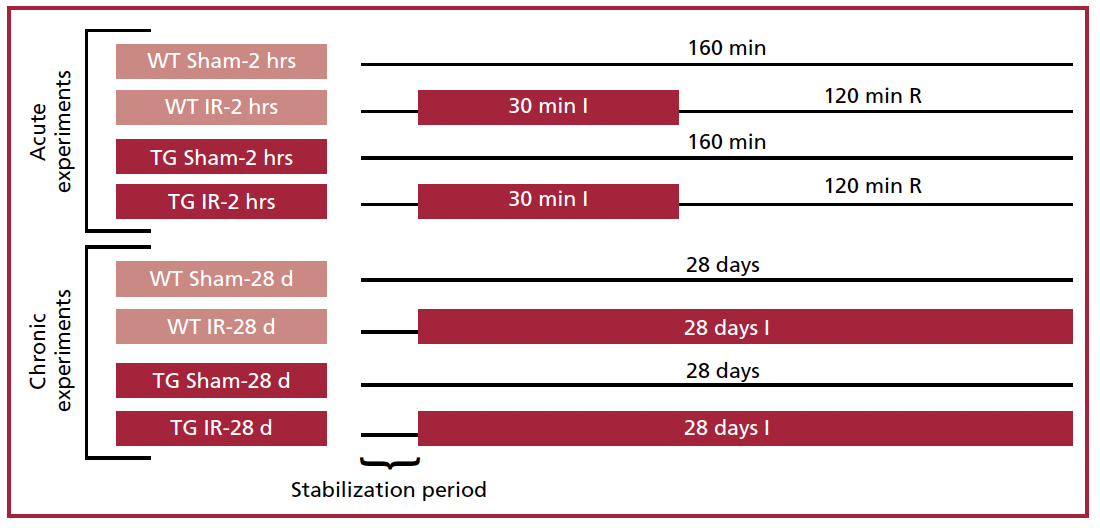
Methods: Transgenic mice (TG) overexpressing cardiac Gs-α and its wild-type variant (WT) were subjected to 30-minute regional myocardial ischemia followed by 2-hour reperfusion (IR) or non- reperfusion (I) with a 28-day follow-up period. Infarct size (IS) was quantified using 2,3,5-triphenyltetrazolium chloride and left ventricular function was evaluated by echocardiography and LV catheterization. Each experimental group was accompanied by a control group (WT/TG Sham-2hrs and WT/TG Sham-28d).
Results: There were no significant differences in IS after IR between TG and WT mice (57.3 ± 3.5% vs. 59.2 ± 2.5%, respectively, p = NS). The heart rate in TG mice was higher throughout the experiment. With ischemia, a in ejection fraction (WT: Sham-28d: 82 ± 2.4% vs. I-28d: 44 ± 4% and TG: Sham-28d 89 ± 2% vs. I-28d 42 ± 3%; p <0.05) was observed together with a decrease in shortening fraction and left ventricular fractional area changes compared with baseline values and their respective control (Sham) groups. However, no differences were observed between the WT and TG groups.
Conclusions: Cardiac Gs-α protein overexpression does not increase infarct size or modify left ventricular function in acute ischemia / reperfusion and chronic infarction compared with their respective controls.
How to cite this article:
Franco-Riveros VB, Buccholz B, Méndez Diodati N, Bernatené EA, Gelpi RJ. Myocardial Infarction in a Murine Model of Cardiac Sympathetic Hyperactivity. Rev Argent Cardiol 2021;89:501-505.
Downloads
Published
Issue
Section
License
Copyright (c) 2021 Argentine Journal of Cardiology

This work is licensed under a Creative Commons Attribution-NonCommercial-ShareAlike 4.0 International License.





