
Evolución histórica comparativa de dos formas clínicas de angina inestable
pp 241-246
DOI:
https://doi.org/10.7775/rac.v60i3.3301Resumen
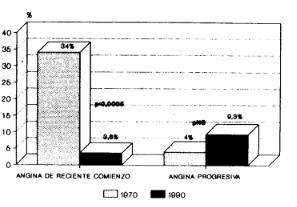
Con el objetivo de analizar la evolución actual de la angina inestable y compararla con la historia natural de esta entidad, efectuamos un estudio prospectivo basado en el seguimiento de 136 pacientes consecutivos ingresados en la unidad coronaria con diagnóstico de angina de reciente comienzo (n: 57) 0 angina progresiva (n: 79) con un período de observación de cuatro meses. La incidencia de infarto de miocardio y la mortalidad fueron del 3,6 % Y del 0 % para la angina de reciente comienzo vs 9,3"10 Y 5,3 % para la angina progresiva (p: NS). La necesidad de tratamiento invasivo por angina refractaria resultó mayor para la angina progresiva (29,3"10 vs 14,5"10 P < 0,05). AI comparar las cifras actuales de infarto y muerte con las observadas veinte años atrás, observamos una sensible reducción de las mismas para la angina de reciente comienzo (infarto, de 34"10 a 3,6 %; muerte, de 8,5"10 a 0 %), mientras que la evolución de la angina progresiva no mostró variaciones significativas. ConcIuimos que la notoria disminución de la incidencia de infarto y muerte producida en los pacientes con angina inestable en los últimos años se concentra particularmente en las formas de reciente comienzo. En la actualidad, un enfoque conservador para el manejo de esta forma cIínica de angina inestable ha dado, según nuestra experiencia, resultados muy favorables.
Descargas
Publicado
Número
Sección
Licencia
Derechos de autor 2026 Revista Argentina de Cardiología

Esta obra está bajo una licencia internacional Creative Commons Atribución-NoComercial-CompartirIgual 4.0.





