
Infective Endocarditis in Argentina. Results of the EIRA 3 Study
pp. 19-27
DOI:
https://doi.org/10.7775/rac.v86i1.1076Keywords:
Infective endocarditis- Epidemiology- Prosthetic cardiac valve- Hospital mortalityAbstract
Introduction: The clinical and epidemiological characteristics of infective endocarditis (IE), a complex disease with high morbidity and mortality, have been changing over the time. Our country lacks updated information since the publication of the EIRA 1 and 2 studies.
Objective: The aim of this study is to analyze the epidemiology, clinical and microbiological characteristics and hospital out come of IE.
Methods: We conducted a prospective multicenter observational study of patients with definite IE according to the modified Duke criteria.
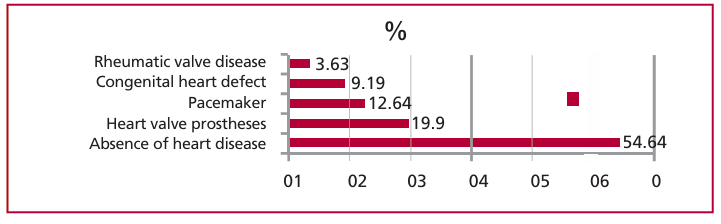
Results: A total of 502 patients [mean age 60.7±19.3 years, 69.9% (n=351) were men] were recruited from 48 centers; 54.64% of the patients (n = 274) did not present underlying heart disease and 37.1% (n=191) had history of a healthcare-related procedure. The diagnosis was made within one month after the first clinical manifestation in 73.3% (n=368). The aortic valve
was most commonly affected in native and prosthetic valves (48.24%; n=233), followed by mitral valve involvement (25.88%; n=125). The most common germs found were Staphylococcus spp 46.3% (n=210), Streptococcus spp 28.2% (n=128) and Enterococcus 12.8% (n=58). Blood cultures were negative in 48 patients (9.76%). Complications: heart failure (30.9%; n=155), peripheral embolism (19.6%; n = 98) and abscess (15.5%; n = 78). Adequate empirical antibiotic treatment was administered
to 62.4% of the patients and 43.3% received surgical treatment (n=218). Overall hospital mortality was 25.5% (n=128). Age, history of chronic kidney failure, mitral valve affection and heart failure were independent predictors of hospital mortality.
Conclusions: A high percentage of patients with IE do not present known prior heart disease. Staphylococcus spp was the most common microorganism. Mortality remains high and similar to the one observed in the EIRA 1 and 2 studies.
Downloads
Published
Issue
Section
License
Copyright (c) 2018 Argentine Journal of Cardiology

This work is licensed under a Creative Commons Attribution-NonCommercial-ShareAlike 4.0 International License.





