
Efficacy and Safety of Transfemoral Transcatheter Aortic Valve Replacement under General Anesthesia versus Local Anesthesia with Conscious Sedation
pp. 33-39
DOI:
https://doi.org/10.7775/rac.es.v86.i1.12981Keywords:
Aortic stenosis, transcatheter aortic valve replacement, general anesthesia, local anesthesia.Abstract
Background: Currently, there is no consensus about the most adequate anesthetic management in transfemoral transcatheter
aortic valve replacement. Although it has been shown that local anesthesia (LA) with or without conscious sedation is feasible,
clinical results are controversial.
Objective: The aim of this study was to evaluate the safety and efficacy of transfemoral transcatheter aortic valve replacement
performed under general anesthesia versus local anesthesia with conscious sedation.
Methods: This was a single-center, retrospective study of high risk patients with severe aortic stenosis undergoing transfemoral
transcatheter aortic valve replacement between March 2009 and December 2016. The population was divided according to anesthetic management. Safety and efficacy outcomes were evaluated at 30-days and were classified according to definitions of the Valve Academic Research Consortium-2. In addition, key times during hospitalization were evaluated.
Results: A total of 121 patients undergoing transfemoral transcatheter aortic valve replacement under general anesthesia (n=55,45.5%) or local anesthesia with conscious sedation (n=66,54.5%). were included in this analysis. Mean age was 83.2±5.7 years and 48.8% were men. There were no differences in either the procedural result or in the 30-day efficacy and safety outcomes.
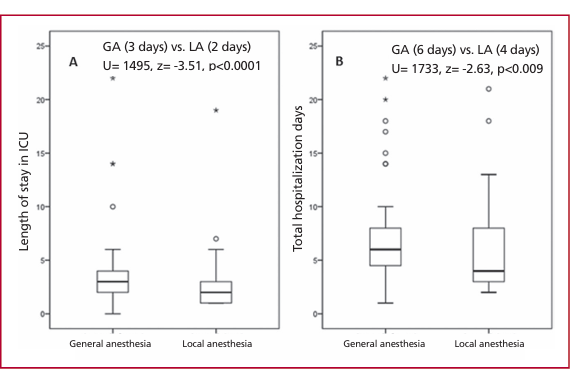
The rate of death at 30-days was 7.3% in the group with general anesthesia and 3% in the local anesthesia with conscious sedation group (log-rank p 0.28). The need of conversion to general anesthesia was 3% (2 patients), in all cases due to major vascular complications during the procedure. In the local anesthesia with conscious sedation group shorter procedural time, intensive care unit and hospital length of stay were observed.
Conclusions: Transfemoral transcatheter aortic valve replacement performed under local anesthesia with conscious sedation
seems to be a safe and effective alternative to the use of general anesthesia.
Downloads
Published
Issue
Section
License
Copyright (c) 2018 Argentine Journal of Cardiology

This work is licensed under a Creative Commons Attribution-NonCommercial-ShareAlike 4.0 International License.





