Patients with ST-Segment Elevation Acute Myocardial Infarction Transferred to Centers with Percutaneous Coronary Intervention Capabilities. National Survey of ST-Segment Elevation Acute Myocardial Infarction in Argentina (ARGEN-IAM-ST)
pp 90-99
DOI:
https://doi.org/10.7775/rac.es.v85.i2.10287Keywords:
Myocardial Infarction, Angioplasty, FibrinolyticsAbstract
Background: In Argentina, the use of primary percutaneous coronary intervention as a reperfusion strategy in ST-segment elevation acute myocardial infarction (STEMI) patients has progressively increased based on formal or informal patient transfer networks. The use and time delays produced by patient transfer have not been universally explored in our country.
Objective: The aim of this study was to evaluate the frequency of STEMI patient transfer to centers with percutaneous coronary intervention capabilities, the reperfusion strategy adopted (primary percutaneous coronary intervention, thrombolytic therapy, rescue percutaneous coronary intervention or pharmacoinvasive strategy) and the system delays.
Methods: A prospective, observational, multicenter study was conducted in 247 centers in all the Argentine provinces. A total of 1,661patients with STEMI lasting <36 hours were included in the study from March to December 2015.
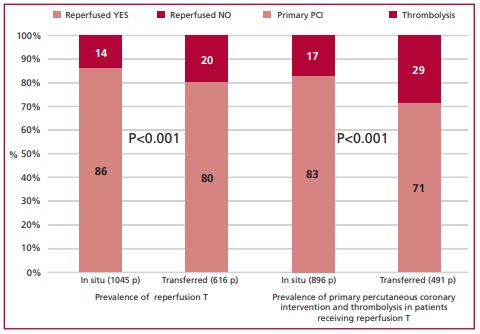
Results: Mean age was 61±11.9 years and 77.6% were men. The average prevalence of patient transfer from other centers for reperfusion therapy was 37% (95% CI: 34.80-39.44) nationwide. The overall use of reperfusion therapy was lower in patients transferred than in those treated in situ [80% vs. 86% (OR: 0.65; 95% CI: 0.50-0.84; p <0.001)]. Considering only those patients treated with reperfusion strategies, the use of primary percutaneous coronary intervention was lower in patients transferred [71% vs. 83% (OR: 0.51; 95% CI: 0.39-0.67)], while the use of thrombolytic therapy was higher [29% vs. 17% (OR: 1.92; 95% CI: 1.48-2.50)] (p <0.001). Rescue percutaneous coronary intervention was performed in 41 patients transferred versus 12 patients treated in the center of the first medical contact, while pharmacoinvasive treatment was used in only 12 patients, 6 of them transferred from another center. Total ischemic time from onset of symptoms to primary percutaneous coronary intervention was 350 minutes (IQR 25-75: 235-650) in patients transferred and 245 minutes (IQR 25-75:170-450) in those treated in the center of the first medical contact (p <0.001). Door-to-balloon time was 85 minutes (IQR 25-75: 50-153) vs. 95 minutes (IQR 25-75: 62-150) in patients transferred and not transferred, respectively (p=0.01). In patients transferred, the symptom-to-needle time in patients treated with thrombolysis before referral was 165 minutes and in those transferred for percutaneous coronary intervention the symptom-to-balloon time was 350 minutes, with a difference of 185 minutes. The delay between the access to thrombolysis in situ and transfer for percutaneous coronary intervention was 140 minutes.
Conclusions: In our country, one out of three STEMI patients is transferred to another center for reperfusion therapy. Patients transferred are less likely to receive reperfusion therapy and to undergo primary percutaneous coronary intervention. The time difference between patients who received thrombolysis before being transferred and the waiting time to undergo primary percutaneous coronary intervention was >2 hours. The use of pharmacoinvasive treatment was very low. The availability of resources in the participating centers indicate that a better articulation of patient transfer networks could improve the time delays to treatment and reduce STEMI-related morbidity and mortality in Argentina
Downloads
Published
Issue
Section
License
Copyright (c) 2025 Argentine Journal of Cardiology

This work is licensed under a Creative Commons Attribution-NonCommercial-ShareAlike 4.0 International License.