
Cardiopulmonary Exercise Testing Contributes to Accurate Risk Assessment in Patients with Low-risk Pulmonary Hypertension
pp. 130-134
DOI:
https://doi.org/10.7775/rac.es.v91.i2.20613Keywords:
Hypertension, Pulmonary, Risk Assessment, Oxygen Consumption, Exercise Tolerance, Exercise TestAbstract
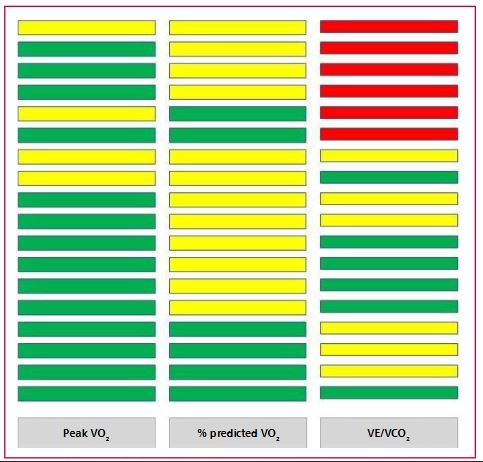
Background: European guidelines for pulmonary arterial hypertension (PAH) stratify the risk using clinical characteristics and complementary studies, including the cardiopulmonary exercise test (CPET). This takes into account 3 parameters: peak O2 con-sumption (peak VO2), its percentage with respect to the predicted VO2, and the minute ventilation/carbon dioxide production (VE/VCO2) slope. However, none of the models that validated this way of stratifying risk included PCPE among their variables.
Objectives: To determine what proportion of patients with group I PAH considered to be at low risk and who walk >440 meters in the 6-minute walk test (6MWT) have parameters considered to be of moderate or high risk in the PCPE.
Methods: Patients >18 years of age, diagnosed with group I PAH at low risk of events, who walked >440 meters in the 6MWT and had NT-proBNP value < 300 pg/dL were included. A CPET was performed in which the peak VO2, its percentage with respect to the predicted VO2, and the VE/VCO2 slope were recorded. It was determined what proportion of patients presented these parameters in a higher than low risk stratum (peak VO2 consumption ≤15 ml/min/Kg, its percentage with respect to the predicted VO2≤65% and the VE/VCO2 slope ≥ 36).Results: Eighteen patients were included. Despite being low-risk patients with a good functional class, all patients presented a peak VO2 less than 85% of predicted, which determines a deterioration of functional capacity. A single patient (6%) presented the three parameters evaluated at low risk, 8 patients (44%) had at least one altered parameter, 7 patients (39%) presented 2 altered param-eters and in 2 patients (11%) all parameters were altered. The parameters that were most frequently altered were the percentage of predicted peak VO2 and the VE/VCO2 slope in 67% of the cases. Only 4 patients presented a peak VO2 <15 ml/kg/m. No patient presented peak VO2 values or percentage of predicted VO2 in the high-risk category. However, 6 patients (33%) presented a high-risk VE/VCO2 slope.
Conclusion: Majority (92%) of the patients considered low risk and who walk more than 440 meters in 6 minutes presented at least one altered variable in the CPET. The VE/VCO2 slope and the percentage of predicted peak VO2 consumption were the most fre-quently altered variables. The VE/VCO2 slope was the only one...
How to cite this article:
Bluro I, Barbagelata L, Coronel M, Melatini L, Svetliza G, Vulcano N, et al. Cardiopulmonary Exercise Testing Contributes to Accurate Risk Assessment in Patients with Low-risk Pulmonary Hypertension. Rev Argent Cardiol 2023;91:130-4
https://doi.org/10.7775/rac.es.v91.i2.20613
Downloads
Published
Issue
Section
License
Copyright (c) 2023 Argentine Journal of Cardiology

This work is licensed under a Creative Commons Attribution-NonCommercial-ShareAlike 4.0 International License.





