
Prognostic value of brain natriuretic peptide and troponin I in moderate and high risk pulmonary embolism
pp. 271-2
DOI:
https://doi.org/10.7775/rac.es.v80.i4.1329Keywords:
Pulmonary Embolism, Brain Natriuretic Peptide, Troponin, Risk stratificationAbstract
Background: Brain natriuretic peptide (BNP) and troponins are useful markers for risk stratification in pulmonary embolism (PE). However, it is not clear which of the two biomarkers has better association with the clinical severity of this condition.
Objective: The aim of this study was to assess both biomarkers in moderate and high risk populations.
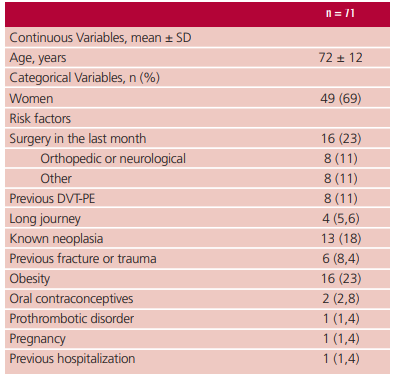
Methods: A prospective study was undertaken to analyze all patients diagnosed with PE who had positive troponin I (TI) or BNP levels. An echocardiogram within the first 24 hours and clinical follow-up during hospitalization were performed. A composite endpoint of death, recurrent PE, shock, hypotension, mechanical respiratory assistance, and thrombolytic therapy was established. The association of both serum markers with the described events was assessed.
Results: Seventy-one consecutive patients were included. Patients with moderate or severe right ventricular dysfunction had higher BNP levels (661 pg/ml [420-1113] vs. 316 pg/ml [129-570]; p = 0.002) without significant difference in TI levels (0.115 ng/ml [0.015-0.345] vs. 0.24 ng/ml [0.076-0.58]; p = 0.0788). BNP levels were higher in patients with the composite endpoint [604 pg/ml (370-934) vs. 316 pg/ml (148-900); p = 0.042], whereas no similar association was found for TI [0.12 ng/ml (0.037-0.48) vs. 0.13 ng/ml (0.07-0.41); p = 0.46].
Conclusions: BNP showed higher values in patients with right ventricular dysfunction and in those reaching the composite endpoint, indicating its greater utility to identify patients with more severe clinical involvement.
Downloads
Published
Issue
Section
License
Copyright (c) 2025 Argentine Journal of Cardiology

This work is licensed under a Creative Commons Attribution-NonCommercial-ShareAlike 4.0 International License.





