
Predictors of Disease Progression and Mortality in Patients with Heart Failure and Preserved Systolic Function
pp 256-263
DOI:
https://doi.org/10.7775/rac.v71i4.2925Keywords:
heart failure, congestive, mortality, prognosis, risk assessmentAbstract
Objectives
The main objective ofthis study was to analyze the variables associated with mortality and hospitalizations for worsening heart failure in patients with heart failure and preserved systolic function. On the other hand, we built and validated a mortality clinical prediction rule in this population.
Methods
From 2279 consecutive patients included in the GESICA heart failure registry, we analyzed 401 individuals with ejection fraction >40%. This group was characterized by a mean age of 70 years old, 41 % of women, 57% in class 111/IV and 24% with ischemic cardiopathy. During the 540 days of follow-up, 14.4% ofpatients were hospitalized for the first time due to heart failure and 15.2% died.
Results
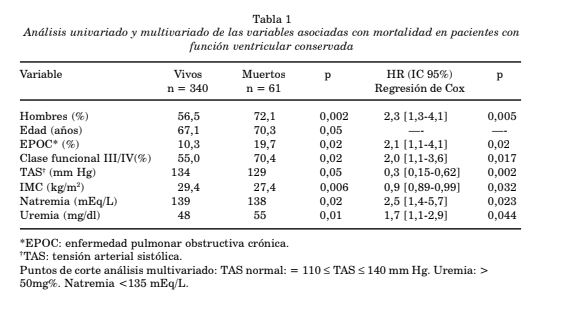
The only independent variable associated with hospitalization due to heart failure was the number ofhospitalizations in the previous year: HR l. 72 (1.0-2.97), p=0.05; .2:_2 hospitalizations: HR 2. 78 (1.15-6. 72), p=0.023. The independent redictive variables of mortality were: functional class, uremia, natremia, chronic obstructive pulmonary disease, male gender, body mass index and systolic blood pressure < 110 or > 140 mmHg. Male gender, chronic obstructive pulmonary disease and high systolic blood pressure predicted mortality only in patients without systolic dysfunction.
Conclusion
Among the patients with heart failure and preserved ventricular function, the variables associated to a worse clinical condition predict higher mortality, whereas previous hospitalizations are associated only to new hospitalizations for worsening of the heart failure.
Downloads
Published
Issue
Section
License
Copyright (c) 2026 Argentine Journal of Cardiology

This work is licensed under a Creative Commons Attribution-NonCommercial-ShareAlike 4.0 International License.





