Prognostic value of prior aspirine use is modified byc-reactive protein but not by troponin t levels in un-stable angina patient
pp 75-82
DOI:
https://doi.org/10.7775/rac.v71i2.2964Keywords:
aspirin, C Reactive Protein, inflammation, unstable anginaAbstract
Objective
To evaluate the association between CRP / TnT levels and prior aspirin administration in patients (pts) with unstable angina (UA).
Methods
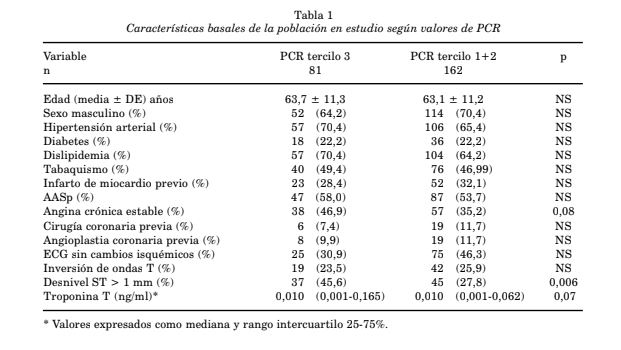
In a multicentre study 243 consecutive patients admitted toCoronary Unit with UA were included. Blood samples wereobtained for CRP and TnT measurements 8-24 hours afterthe last painful episode. CRP values when ³ 1.0 mg/dl (thirdtercile) were considered elevated (CRP+). Endpoint (EP) wasthe in-hospital incidence of death, myocardial infarction and/or refractory angina.
Results
Mean age 63.0±11.0 years, 68.3% male patients, ST-segment deviation (STd) 32.1%, TnT + 37.4%, pASA 55.1%, EP 11.1%.CRP levels were similar in pts with or without pASA. The pASA patients had higher EP rate (15.7% vs. 5.5%; p < 0.05,OR 3.2, IC 95% 1.2-8.2), but this difference was not significant after adjusting for TnT, STd, age and prior MI. OR forEP of pASA was 1.5 (CI 95% 0.4-6.5) in CRP+ pts, and 5.0 (CI95% 1.4-18.0; p <0.01) in CRP- pts. In the second group of pts, pASA was the only independent predictor of EP in a logistic regression model after adjusting for age, prior MI, priorCABG, diabetes, STd, and TnT elevation (OR for pASA 4.7,CI 95% 1.3-17.0, p= 0.02). No association was observed be-tween CRP values and EP (pts with EP: CRP 1.46±3.1 mg/dl, pts without EP: CRP 1.29±3.01mg/dl, p= ns).
Conclusion
The prognostic value of pASA is modified by CRP values:pASA is independently associated to a worse prognosis only in patients with lower CRP values at presentation.
Downloads
Published
Issue
Section
License
Copyright (c) 2026 Argentine Journal of Cardiology

This work is licensed under a Creative Commons Attribution-NonCommercial-ShareAlike 4.0 International License.