High Speed Rotational Coronary Atherectomy. Are Angiographic Factors Predictive of Failure, Major Complications or Restenosis? A Multivariate Analysis
pp 165-172
DOI:
https://doi.org/10.7775/rac.v62i2.3337Keywords:
Rotational coronary atherectomy, Restenosis, Lesion sizeAbstract
Background
Although several angiographic features are usually considered to assess the likelihood of restenosis, major complications and failure after PTCA, no such experience has been accumulated with the use of rotational atherectomy.
Objectives
In order to determine the predictive value for failure, major complications and restenosis after rotational atherectomy, 12 angiographic variables were included in a logistic regression multivariate analysis using a quasi Newton method and a maximal probability technique.
Material and method
One hundred-twenty coronary arteries in 113 patients were analized. The angiographic features considered were: 1) coronary artery treated; 2) type of obstruction (A, B and C, Task Force, American Heart Association,College of Cardiology); 3) lesion length; 4) lesion excentricity; 5) lesion angulation; 6) presence of calcium; 7) ostial lesions; 8) lesions at a coronary bifurcation; 9) restenotic lesion; 10) severity of preprocedural obstruction; 11) residual stenosis postrotational atherectomy and 12) final stenosis
Results None of the variables analysed was statistically significant for failure or major complications (overall incidence 36.5 %) was 2.41 times more probable in long lesions (< 10 mm 12/56-21.4%; 10-20 mm 6/9-66.7%;> 20 mm 6/12-50%) and 3.46 times more probable in non calcified arteries (calcified 7/36-19.4%; non calcified 17/41- 51.5%). The incidence of restenosis was 11.3o%o for short (< 10 mm) and calcified lesions. Chisquare analysis revealed that type C lesions correlated significantly with a higher incidence of failure: typeA 0/7; type B10/44; type B2 0/47 and type C 3/22(p<0 .003). Conclusions In patients treated with rotational atherectomy: 1) the angiographic variables considered were not predictive of major complications;2) failure occurred when treating type C lesions in totally occluded arteries and 3) restenosis was more frequent in long and non calcified lesions.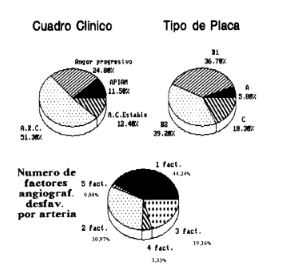
Downloads
Published
Issue
Section
License
Copyright (c) 2026 Argentine Journal of Cardiology

This work is licensed under a Creative Commons Attribution-NonCommercial-ShareAlike 4.0 International License.