Cardiovascular Evidence Gaps in Adults Over 80 Years of Age. Part 2. Roundtable Results: Atrial Fibrillation and Acute Coronary Syndromes
pp. 253-262
DOI:
https://doi.org/10.7775/rac.es.v94.i4.21014Keywords:
Frailty, Comprehensive assessment in cardiology, Evidence-based medicine, Atrial fibrillation, Acute coronary syndromes, Older adultsAbstract
Background: Clinical practice guidelines have limitations when applied to patients
> 80 years with atrial fibrillation (AF) or acute coronary syndrome (ACS), due to their underrepresentation in clinical trials and the interplay between frailty, multimorbidity, polypharmacy, functional status, and cognitive decline—factors that influence the appropriateness of interventions.
Objectives: The aim of this paper is to discuss gaps in management and to describe consensus -based therapeutic strategies for patients > 80 years with AF or ACS using a structured consensus methodology.
Methods: An in-person roundtable was held with 34 cardiologists and 6 geriatricians. Clinical scenarios for AF and ACS were analyzed and stratified into three functional categories: robust, mild frailty, and moderate frailty, with structured discussion and anonymous voting.
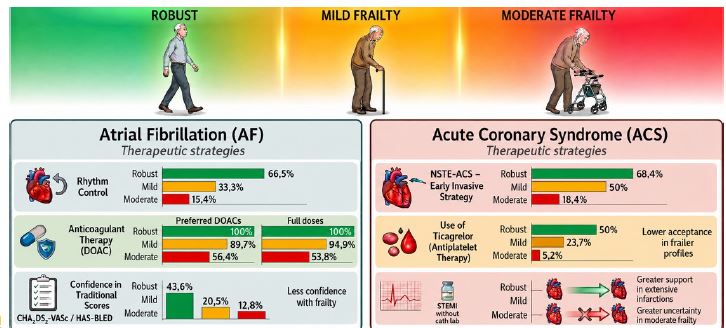
Results: Therapeutic decisions varied consistently with frailty category. In AF, the acceptance rate of rhythm control in newly diagnosed cases decreased with frailty (66.5% in the robust group versus 15.4% in the moderate frail group), even in the presence of cognitive decline. Beta-blockers were the most widely accepted pharmacologic option, with low support for digoxin and chronic amiodarone. Confidence in the CHA₂DS₂-VASc and HAS-BLED scores was low and decreased with frailty. Direct oral anticoagulants were the preferred option, although they were less widely accepted in cases of moderate frailty; acetylsalicylic acid was not supported as an alternative. In non-ST-segment elevation acute coronary syndrome (NSTE-ACS), acceptance of an early invasive strategy and the use of ticagrelor decreased with frailty. In ST-segment elevation ACS (STE-ACS) without access to cardiac catheterization laboratory, fibrinolytic therapy was considered an alternative, with greater support for more extensive infarcts and lower acceptance in cases of moderate frailty.
Conclusions: Frailty consistently influenced the treatment decisions reached by consensus in patients > 80 years with AF or ACS, with less acceptance of intensive strategies with higher levels of frailty. These findings underscore the need to incorporate a comprehensive assessment into cardiovascular decision-making.
Downloads
Published
Issue
Section
License
Copyright (c) 2026 Argentine Journal of Cardiology

This work is licensed under a Creative Commons Attribution-NonCommercial-ShareAlike 4.0 International License.