mplication of Left Main Coronary Artery Disease on Coronary Artery Bypass Graft Surgery Results
pp. 489-495
DOI:
https://doi.org/10.7775/rac.es.v88.i6.19102Keywords:
Coronary Artery Bypass, Cardiac Surgical Procedures, Cause of Death, Heart Bypass, LeftAbstract
Background: Coronary artery bypass graft surgery (CABG) has been the indicated approach for the treatment of left main coronary artery (LMCA), disease with percutaneous coronary intervention (PCI) as an alternative treatment in a highly selected group of patients. However, the non-inferiority criteria of PCI outcomes in terms of mortality and acute myocardial infarction (AMI) in the mid-term follow-up are currently subject of debate.
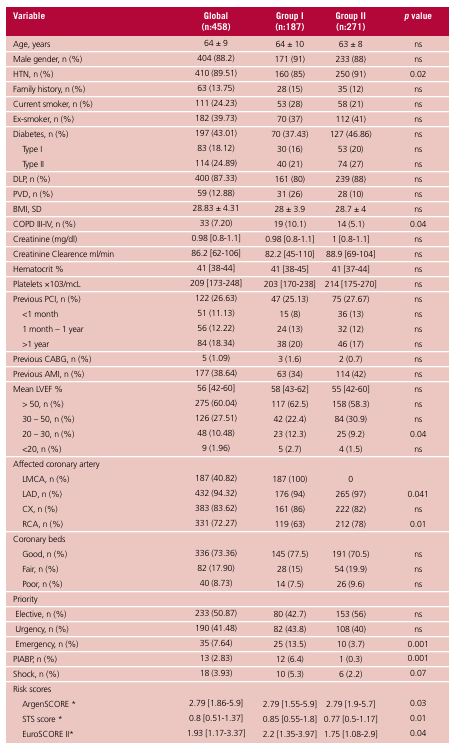
Objective: The aim of this study was to evaluate the clinical, functional and angiographic characteristics of patients undergoing CABG with and without LMCA disease, and the implications of morbidity and mortality encountered.
Methods: A total of 458 consecutive patients underwent CABG; 187 (40.82%) presented LMCA disease. This group had a higher risk profile compared with the group without LMCA disease: ArgenSCORE: 2.78 (1.55-5.9) vs. 2.78 (1.95-7); p=0.03, STS score: 0.85 (0.55-1.8) vs. 0.77 (0.5-1.17); p=0.01 and EuroSCORE II: 2.2 (1.35-3.97) vs. 1.75 (1.08-2.9); p=0.04.
Results: Despite the higher expected risk, there were no statistically significant differences in mortality (3.2% vs. 1.1%), AMI (2.6% vs. 1.1%) and stroke (1% vs. 0.3%) in the two groups. In the multivariate analysis, LMCA disease was not a predictor of morbidity and mortality (HR=2.1; 95% CI 0.70-6.23; p=0.18) and positively identified the preoperative ejection fraction (HR=0.96; 95% CI 0.93-0.99; p=0.040) and non-programmed surgery (HR=3.44; 95% CI 1.60-7.41; p=0.002).
Conclusions: In our experience, LMCA disease in patients undergoing CABG is not a predictor of death, AMI and/or stroke.
Downloads
Published
Issue
Section
License
Copyright (c) 2025 Argentine Journal of Cardiology

This work is licensed under a Creative Commons Attribution-NonCommercial-ShareAlike 4.0 International License.