
Trends in Myocardial Due to Acute Myocardial Infarction in Argentine between 1980-1997
pp 733-738
DOI:
https://doi.org/10.7775/rac.v67i6.3823Keywords:
Infarto agudo de miocardio, Epidemiología, Mortalidad, Estadísticas nacionales de saludAbstract
Coronary heart disease remains as the principal cause of death in the United States and in many European countries. Because of the lack of comparative data in our country, our aim was to examine the contemporary trends in mortality from acute myocardial infarction between 1980 and 1997. We analyzed the data-base of vital statistics corresponding to 1980, 1985, 1990 and 1997 from the National Program of Health Statistics. The criteria used for the codification of the basic cause of death, assigned in death certificates, were based on International Classification of Diseases (ICD 9't'Revision and 10th Revision). We calculated the annual mortality rate in the general population and the specific rate adjusted for age and sex per 100,000 according to national census data. Although cardiovascular diseases remain as the leading cause of death in our country, we observed a reduction of 31% in the total mortality rate from 1980 through 1997. The coronary heart disease mortality rate decreased in 33% in the same period. The total mortality rate due to acute myocardial infarction fell from 61 per 100,000 in 1980 to 42 per 100,000 in 1997 (31% reduction). This decline was more prominent in men in the different groups of age considered and in women older than 75 years. Conclusions From 1980 to 1997, we observed a significant trend to the reduction of mortality due to coronary heart disease and acute myocardial infarction.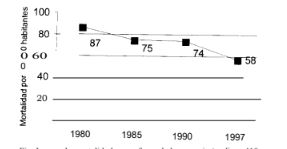
Downloads
Published
2026-04-13
Issue
Section
ORIGINAL ARTICLES
License
Copyright (c) 2026 Argentine Journal of Cardiology

This work is licensed under a Creative Commons Attribution-NonCommercial-ShareAlike 4.0 International License.





