
Vasoplegic Syndrome After Cardiac Surgery. Mortality Reduction due to Methylene Blue
pp 524-529
DOI:
https://doi.org/10.7775/rac.v69i5.3849Keywords:
Methylene blue, Vasoplegic syndrome, Cardiac surgery, Post-operatory mortality, Inflammatory responseAbstract
Objectives 1) To analize the incidence of post-operatory vasoplegic syndrome. 2) To consider its prognosis. 3) To assess the effect of methylene blue over mortality. Material and methods All cardiac surgeries performed in the participating centers were included. Vasoplegic syndrome was defined in the presence of five criteria: 1) hypotension (MAP less than 50 mm Hg), 2) low filling pressures, 3) high or normal cardiac index (over3 liters), 4) low peripheral resistance (less than 800 dynes), 5) vasopressor requirement. Those with vasoplegic syndrome were randomized to receive1.5 mg/kg of methylene blue or placebo. A p values less than 0.05 was considered significant. Results 249 surgeries were consecutively included. Thirty of them fullfilled the vasoplegia criteria (12%), resulting in higher mortality (20% [6 of 30 patients] against 4.1% [9 of 219 patients]; p=0.004). Those treated with methylene blue showed morbidity and mortality reduction (0% [0/15 patients] against40% [6/15 patients] in the control group; p = 0.008). The length of the vasoplegic syndrome was shorter in those treated with methylene blue, lasting six hours in all cases. Patients in the control group showed a slower evolution, 8 (53.3%) with vasoplegia lasting more than 48 hours, and 6 deaths (0%[0/7 patients] against75% [6/8 patients]; p =0.05)for methylene blue and control patients, respectively. Conclusions 1)12% of the operated patients showed vasoplegic post-operatory syndrome. 2) Their prognosis was worse, with increased mortality. 3) The use of methylene blue reduced the high mortality rate in this population.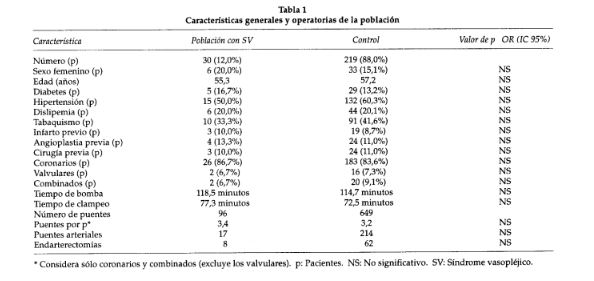
Downloads
Published
2026-04-13
Issue
Section
ORIGINAL ARTICLES
License
Copyright (c) 2026 Argentine Journal of Cardiology

This work is licensed under a Creative Commons Attribution-NonCommercial-ShareAlike 4.0 International License.





