National Registry of Hypertension. Awareness, Treatment and Control of Hypertension. The RENATA Study
pp 121-129
DOI:
https://doi.org/10.7775/rac.v80i2.1902Keywords:
Hypertension, Prevalence, Awareness, ControlAbstract
National Registry of Hypertension. Awareness, Treatment and Control of Hypertension. The RENATA Study
Background
Hypertension (HT) is one of the main risk factors for cardiovascular disease. The prevalence of HT has increased due to greater life expectancy and prevalence of obesity in the population. The RENATA study (REgistro NAcional de hiperTensión Arterial, National registry of hypertension) was designed due to the lack of updated epidemiological information in our country.
Objectives
To update the prevalence, awareness, treatment and control of HT in Argentina. Material and Methods. We conducted a cross sectional study based on surveys performed on subjects randomly selected from seven cities of the country. Blood pressure (BP) was measured on three occasions using an automated sphygmomanometer; the average of the second and third measurements was consideredfor the analysis.
Results
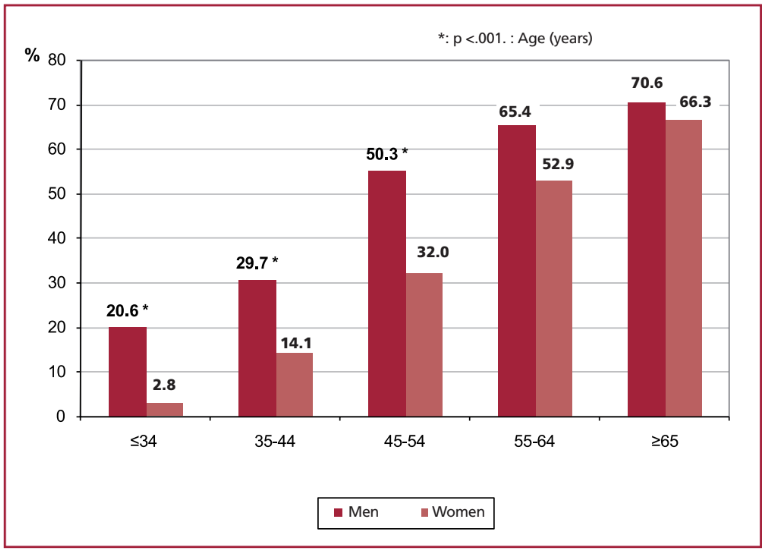
A total of 4006 subjects (average age 43.7 years) were surveyed. The prevalence of HT was 33.5% (95% CI: 31.9- 34.9%) and was greater in men compared to women (41.7% vs. 25.7%; p <0.001). The prevalence increased with age from 11.1% in subjects <35 years to 68.5% in ≥65 years. Among respondents, 37.2% were not aware of their condition (men 44.66% vs. women 25.9%; p <0.001). 56.2% of subjects with HT were receiving therapy, yet HT was well controlled in only 26.5% of them (men 19.8% vs. women 36.8%; p <0.001).
Conclusions
The RENATA study updated the information about the prevalence, awareness and treatment of HT in seven cities in Argentina. Thirty three percent of the population evaluated has HT and this condition is more common in men. The high percentage of patients unaware of having HT and of patients with uncontrolled HT despite of treatment emphasizes the importance of this Registry and reinforces the need of designing specific strategies contributing to improve high BP control in our country.
Downloads
Published
Issue
Section
License
Copyright (c) 2025 Argentine Journal of Cardiology

This work is licensed under a Creative Commons Attribution-NonCommercial-ShareAlike 4.0 International License.