
Selection Test for Applicants to a Residency Program in Cardiology: Variables Associated to the Results
pp 327-331
DOI:
https://doi.org/10.7775/rac.v69i3.3072Keywords:
Medical education, Admission exam, Medical residence, Exam characteristicsAbstract
Objective
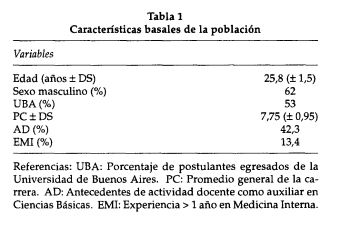
To identify predictors of good performance in a multiple choice test designed to select physicians applying to a cardiology-training programme. Population and methods A 50-question test was designed in two different versions: questions 1-25 in version 1 were the same as questions 26-50 in version 2, and vice versa. The whole population of applicants taking the test was divided in two groups, according to the results. Graduate students in group qualified as good were those who obtained a score beyond the median; those with a score below the median were qualified as no good (score<median). Both groups were compared according to different variables: gender, age, university of procedence, final average score at university (FAS), experience in teaching assistance in basic sciences (TA), and experience in internal medicine (residence or concurrence>1 year).
Results
Ninety-five applicants took the test. The median score was 25. Of all the analyzed variables, onlyt he FAS (p = 0.00002) and the TA were associated with a good performance in the test. There was a tendency to a better performance in those who answered to version 2 (median score 28) versus the responders to version 1 (median score 23) (p = 0.07). Nevertheless, there were no significant differences among the scores of applicants submitted to anyof both versions of the same exam.
Conclusion
The FAS and the experience in TA were the only predictors of a good performance in this selection test. We speculate that the slight (non-significant) difference in performance between those answering version 1 or 2 could be the result of the different order of presentation of the questions
Downloads
Published
Issue
Section
License
Copyright (c) 2026 Argentine Journal of Cardiology

This work is licensed under a Creative Commons Attribution-NonCommercial-ShareAlike 4.0 International License.





