Contractile Reserve by Left Ventricular Ejection Fraction Alone, o Considering Elastance. ¿Which is the Best Predictor of Events After a Stress Echo Without Ischemia?
pp. 329-335
DOI:
https://doi.org/10.7775/rac.es.v90.i5.20560Keywords:
Echocardiography, Stress - Myocardial Contraction - Ventricular Function, Left / physiologyAbstract
Background: The behavior of left ventricular ejection fraction (LVEF) during exercise is used to measure contractile reserve (CR). CR measured by elastance could have greater prognostic value.
Objective: To establish whether the measurement of CR by elastance adds long-term prognostic value to CR measured by LVEF in patients with a Stress Echo without myocardial ischemia.
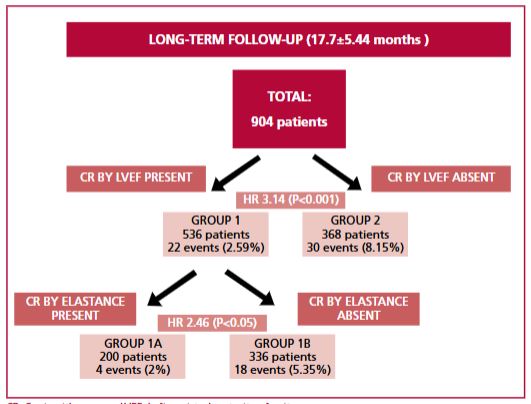
Material and methods: Retrospective study, carried out in 904 patients with an exercise Stress Echo without ischemia. CR was assessed by LVEF and by elastance. Patients were divided into 2 groups: Group 1: presence of CR by LVEF (in turn this group was divided into 2 subgroups: Group 1A, CR with elastance present, and Group 1B: absence of CR by elastance), and Group 2: patients with absence of CR by LVEF. The follow-up was 17,7 ± 5,4 months. Outcomes considered were death, acute myocardial infarction (AMI), stroke, and cardiovascular hospitalization.
Results: 536 patients were included in Group 1, 200 (37,3 %) in Group 1A and 336 (62,7%) in Group 1B. In Group 2, 368
patients were included. At follow-up, patients in Group 2 had more events, 30 (8.1%) vs. 22 (2.6%) (HR 3.14, 95% CI 1.95-5.9,
log rank test p <0.001). Within G1, patients in Group 1B presented more events: 18(5.3%) vs 4 (2%) (HR 2.46 CI 95% 1.06-7.3, log rank test p <0.05). In the regression model, CR assessed by LVEF and additionally by elastance was the only significant outcome predictor (HR 3.2, 95% CI 1.83-5.6, p <0.001).
Conclusions: In an exercise Stress Echo negative for ischemia, CR behavior evaluated by elastance allowed us to identify a subgroup with a worse long-term prognosis in patients with normal LVEF response.
How to cite this article:
Lowenstein Haber DM, Arbucci R, Merlo P, Martínez L, Gastaldello N, Saad AK, y cols. Contractile reserve by left ventricular ejection fraction alone, or considering elastance. ¿Which is the best predictor of events after a Stress Echo without ischemia? Rev Argent Cardiol 2022;90:329-35. http://dx.doi.org/10.7775/rac.v90.i5.2